
Authors: Prof Théophile Nguimfack, Prof Ngo Tong Chantal Marie, Dr Primus Tazanu, Anthony Antem, Dr Hugues Pippie, Enowbachem, Muriel Kinkoh, Guy Beaudry Jengu Jengu, Dr. Metolo Foyet, Dr Julienne Mesumbe, and Dr Denis Foretia
Published on: September 30, 2026
DOI: doi.org/10.64116/Report.2026.DemocracyCentralAfrica
Introduction
Understood as the power (kratos) of the people (demos), democracy is a system of political organization whose original political experience was in the ancient Greek city-state of Athens. In this context, it refers to the direct participation of citizens in the government of the city. Originally implemented as a direct democracy, democracy was defined by Abraham Lincoln as “government of the people, by the people, and for the people.” This idea of democracy, as expressed by Abraham Lincoln in his 1963 speech, seems more like an ideal than a reality. Georges Gurvitch points out that it is important to distinguish between the essence of democracy and the forms of its implementation. The essence of democracy lies in the organization of the distribution of power. The forms of democracy are so varied, yet they share common characteristics that constitute its essence: the sovereignty of the people, which forms the foundation; the participation of the people; and the rule of law. Considering those common characteristics, African states at the first years of independence had tried to implemented democracy but rapidly regarding their fragility, most of the leaders turn to instore authoritarian regime and non democratic system till 1990 where the continent enter to a waste of democratization.
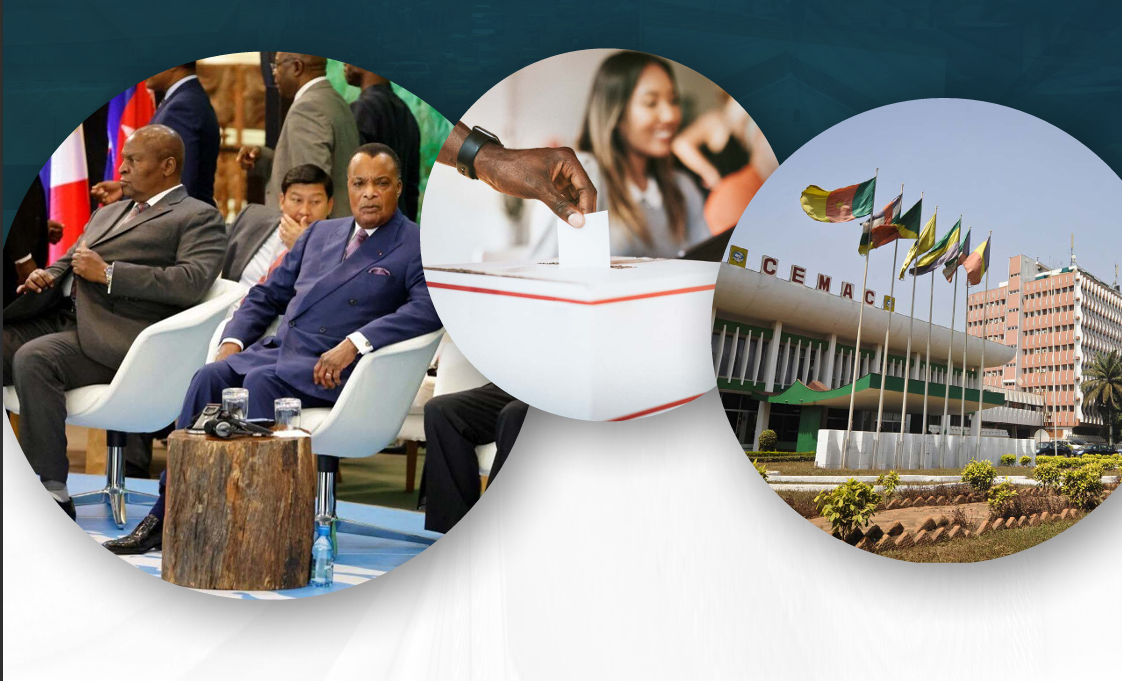
Africa began its transition to democracy after the fall of the Berlin Wall with the Sovereign National Conference of Benin, held from February 19th to 28th, 1990. A pioneer in this area on the African continent, Benin is cited as a model of democracy. Following Benin’s example, other African states embarked on the path of democratization, notably the member states of the Economic and Monetary Community of Central African States (CEMAC).
In Central Africa, the first steps toward a “return to democracy” were taken firstly by Gabon where Omar Bongo decided under the pressure of Civil society and students’ contestations to organize a National Conference which took place from 23th March to 19th April 1990. For the others countries, following the June 1990 La Baule speech, in which France made development aid contingent on “the efforts that states would make to move toward democracy, “Central Africa states consequently embarked on political transitions that followed different paths. While Chad as Gabon did earlier, organized national conferences, Cameroon opted for a tripartite meeting, and the Central African Republic plunged into a cycle of endless crises marked by a few moments of “democratic experiments.” Equatorial Guinea, for its part, proceeded with a controlled opening of the political scene, and Congo-Brazzaville opened up slowly to democracy. The processes set in motion led to constitutional reforms and the organization of elections. Those process of transition to democracy was supported by an emerging Civil society which played a role of catalyzing democratic transition. In fact, with democratic transition, emerge new actors in the political scene named as “forces vives” (syndicates, churches, associations of human rights defense, academic experts) and Non-Governmental Organizations (NGO). Globally refers to the collective of non-governmental organizations, community groups, and associations that operate independently of the state and the market, civil society fosters civic engagement, promotes social justice, and advocates for public interests.

A leading African think tank with a mission to provide independent, in-depth and insightful policy recommendations that allows all Africans to prosper in free, fair, democratic and sustainable economies.



Leave A Comment