
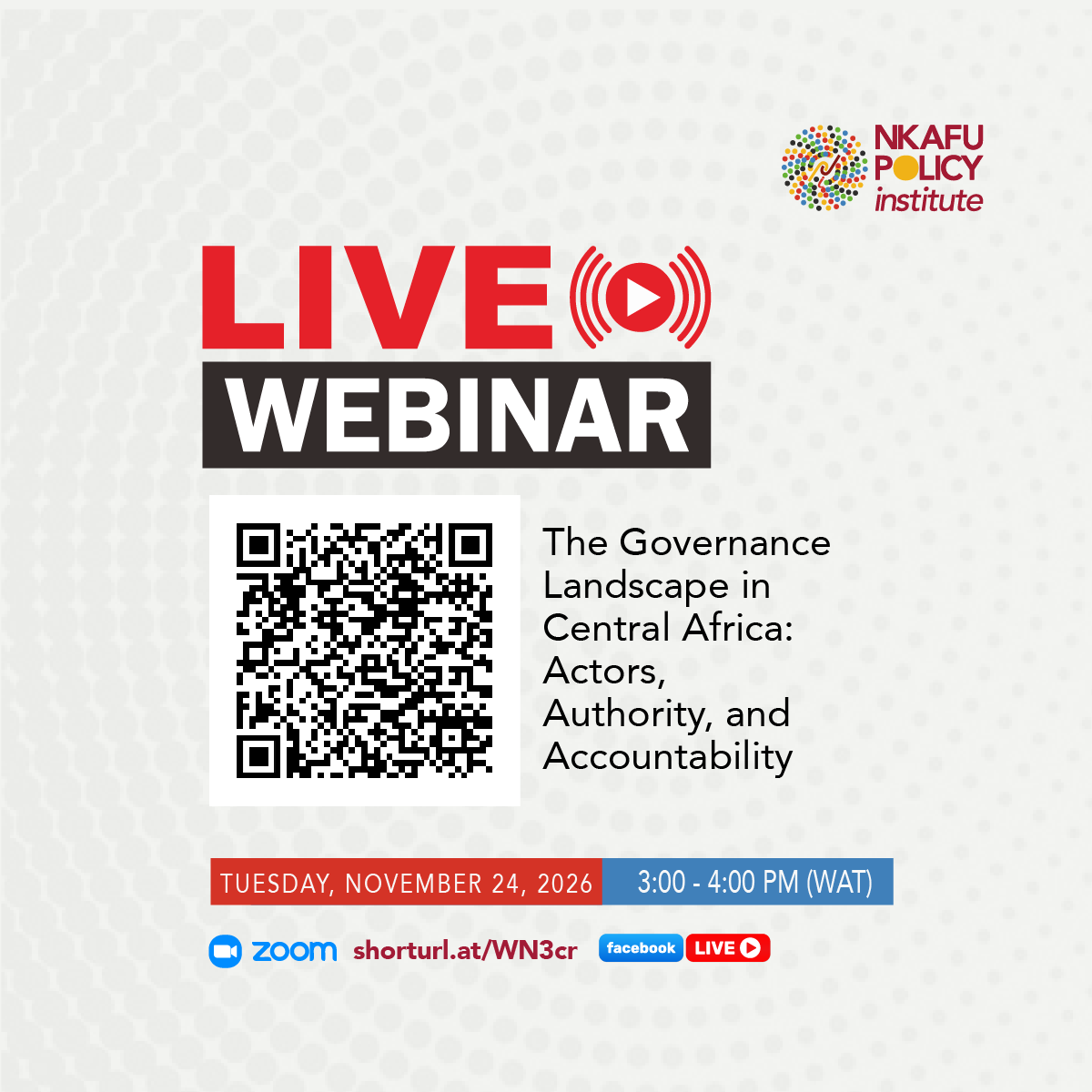
The Governance Landscape in Central Africa: Actors, Authority, and Accountability
Date: Tuesday, November 24, 2026
Time: 3:00 – 4:00 PM (WAT)
Venue: Zoom Online (Register now)
Background and Rationale
Governance outcomes in Central Africa are shaped by a complex ecosystem of actors that extend well beyond formal state institutions. Executive power, security establishments, political parties, traditional authorities, business elites, civil society organizations, religious institutions, and external partners all influence how authority is exercised and how public decisions are made. Understanding this governance landscape is essential for advancing democratic accountability, policy reform, and inclusive development in the region.
Across Central Africa, highly centralized political systems coexist with informal power structures and weak accountability mechanisms. While constitutions and legal frameworks often articulate principles of separation of powers and citizen oversight, the practical operation of governance frequently reflects asymmetries of power, limited institutional checks, and constrained civic space. These dynamics affect public service delivery, economic management, security governance, and public trust in state institutions.
For think tanks, civil society actors, development partners, and reform-minded policymakers, engaging effectively in this environment requires a clear understanding of who holds authority, how decisions are influenced, and where leverage points for accountability and reform exist. This webinar seeks to unpack these dynamics by examining governance actors, formal and informal power relationships, and accountability pathways across Central Africa.
Objectives of the Webinar
The webinar aims to:
- Map key actors shaping governance and decision-making in Central Africa.
- Examine how authority is exercised across formal institutions and informal power networks.
- Analyze the effectiveness of accountability mechanisms, including parliaments, courts, civil society, and the media.
- Identify leverage points for strengthening governance reform and policy influence.
- Foster informed dialogue among policymakers, researchers, civil society, and development partners.
Target Audience
- Policymakers and public officials
- Think tank researchers and analysts
- Civil society and advocacy organizations
- Development partners and donors
- Academics, students, and media professionals
- Practitioners interested in governance reform and policy influence
Expected Outcomes
By the end of the webinar, participants are expected to:
- Gain a clearer understanding of governance actors and power dynamics in Central Africa.
- Identify gaps and opportunities in accountability mechanisms.
- Develop more informed strategies for policy engagement and reform advocacy.
- Strengthen networks among governance actors across the region.
- Contribute to Nkafu’s broader work on governance, democracy, and policy uptake in Central Africa.
About the Nkafu Policy Institute
The Nkafu Policy Institute of the Denis & Lenora Foretia Foundation is a leading independent African policy research institution with vision to accelerate Africa’s Economic Transformation. It drives Africa’s prosperity through evidence-informed policymaking, enabling all citizens to thrive in free, fair, democratic, and flourishing economies. Through rigorous analysis, high-impact publications, and inclusive dialogue, Nkafu promotes practical reforms that strengthen governance and enhance Africa’s development trajectory.
Date
- Nov 24 2026
Time
- 3:00 PM - 4:00 PM
Location
Organizer
-
Nkafu Policy Institute
-
Phone
+237 654 86 72 54 -
Email
[email protected] -
Website
https://nkafu.org/ Catalyzing Africa’s Economic Transformation
Leave A Comment