
By Dr Salim Vessah, Dr Stéphane Atangana & Larissa Ntoubia
Executive summary
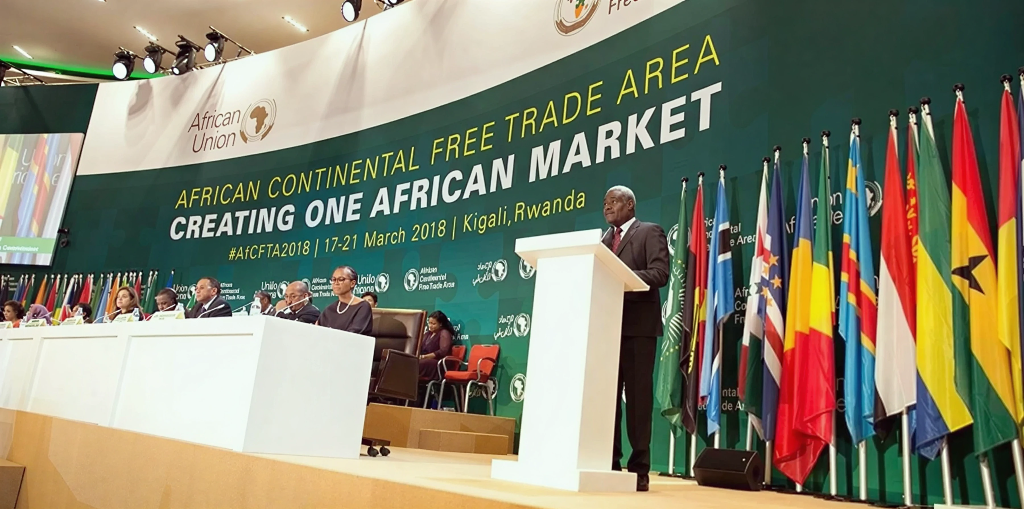
As global geo-economic fragmentation accelerates, African economies face rising external shocks from supply chain reconfiguration, protectionism, and volatile capital flows. The African Continental Free Trade Area (AfCFTA) offers a strategic pathway to build regional resilience, expand industrial capacity, and strengthen economic sovereignty. Yet, despite early trade growth, intra-African trade remains limited, constrained by persistent non-tariff barriers, regulatory fragmentation, weak logistics infrastructure, and insufficient productive capacity. Without deeper domestic and regional reforms, AfCFTA risks delivering trade diversion rather than sustained industrial transformation. This brief argues that Africa’s central challenge is not market access alone, but the absence of industrial cohesion that enables firms to scale, integrate into regional value chains, and compete globally. It proposes a reform agenda focused on accelerated NTB removal, targeted industrial value-chain development, regulatory convergence, digital trade integration, and coordinated continental trade diplomacy. Translating AfCFTA from legal ambition into economic performance is essential for inclusive growth, resilience, and long-term competitiveness in a fragmenting global economy.
Introduction
Global geo-economic fragmentation is reshaping trade, investment, and industrial location decisions. Supply chains are becoming shorter, more regional, and more politically screened. For African economies, this shift raises both risks and opportunities: external markets are becoming less predictable, while regional integration is becoming more valuable as a source of resilience and scale. Yet Africa enters this transition with weak internal trade integration and limited industrial depth. In 2024, intra-African trade reached approximately USD 220 billion, but still represents only 15-18% of total trade, far below Europe or Asia while most manufactured goods consumed on the continent remain imported. The African Continental Free Trade Area (AfCFTA) was designed to address this vulnerability by creating a unified market of 1.4 billion people and USD 3.4 trillion in GDP. However, early implementation suggests that tariff liberalization alone is not delivering the expected industrial momentum. The core bottleneck is not market access, but the absence of industrial and regulatory cohesion: fragmented logistics systems, divergent regulations, weak productive capacity, and uneven business environments prevent firms from scaling across borders and forming competitive regional value chains. As global fragmentation raises the bar for reliability, standards, and scale, these internal weaknesses increasingly limit Africa’s ability to capture relocating investment and integrate into reconfigured supply chains.
This brief advances a central argument: AfCFTA will not generate structural transformation unless it shifts from a trade agreement to a platform for coordinated industrial integration. The originality of this perspective lies in linking Africa’s internal fragmentation directly to its declining competitiveness in a fragmenting global economy. The paper identifies the binding constraints and proposes actionable reforms to convert legal integration into industrial cohesion and economic resilience.
Internal Fragmentation in Africa: A Foundation for Instability
Historical and Structural Roots
Africa’s colonial borders did more than fragment territory; they embedded incompatible legal systems, regulatory practices, and administrative incentives that continue to obstruct market integration under AfCFTA. Today, firms face not a single African market, but a mosaic of overlapping rules that raise transaction costs and discourage cross-border investment. In CEMAC, weak mutual recognition of standards and slow customs harmonization mean that even intra-community shipments face repeated inspections, manual documentation, and unpredictable clearance times, making regional sourcing commercially unattractive despite tariff preferences.
In ECOWAS, although free movement exists legally, truck delays at borders such as Seme-Krake or Paga routinely exceed 24-48 hours due to informal checkpoints, rent-seeking, and inconsistent application of sanitary and customs rules, eroding the competitiveness of regional supply chains. In the EAC, disputes over rules of origin and safeguard measures, particularly affecting textiles, sugar, and cement have periodically triggered unilateral restrictions, undermining investor confidence in regional predictability. These frictions expose the central weakness of AfCFTA implementation: legal integration has advanced faster than operational convergence. Overlapping REC commitments create coordination failures, while national agencies retain discretionary power that dilutes continental commitments. Without resolving this institutional fragmentation, AfCFTA risks becoming a nominal free trade area rather than a platform for scalable industrial production and regional value chains.
Contemporary Economic Barriers
The structural fragmentation of African economies is reinforced by three mutually reinforcing economic barriers that blunt AfCFTA’s trade-creation and industrialization potential.
Transport and logistics costs in Africa frequently absorb 30–50% of final product value, compared to 8-12% in East Asia. On the Lagos–Abidjan corridor, border delays and port congestion add an estimated 20-30% to freight costs, while along the Northern Corridor linking Mombasa to Kampala and Kigali, trucking costs remain nearly double comparable Asian routes despite recent upgrades. In Central Africa, moving a container from Douala to Ndjamena can take longer than shipping the same container from China to West Africa. These costs erode price competitiveness, discourage regional sourcing, and prevent firms from building reliable cross-border supply chains even where tariffs have been eliminated.
Firms expanding regionally face inconsistent customs procedures, divergent standards regimes, and unpredictable enforcement. For example, food processors exporting from Kenya to Tanzania regularly confront changing sanitary certification requirements, while manufacturers operating across UEMOA and non-UEMOA markets face incompatible tax and reporting systems. In CEMAC, overlapping exchange controls and licensing rules raise transaction risks for regional investors. This regulatory fragmentation increases compliance costs and suppresses intra-African investment.
Over 85% of Africa’s manufactured consumption is imported, reflecting thin supplier networks, limited industrial depth, and weak skills ecosystems. High logistics costs and regulatory uncertainty further discourage firms from scaling production, reinforcing a low-industrialization equilibrium where tariff liberalization alone cannot generate sustained trade or value-chain formation.
AfCFTA in the Face of Global Fragmentation: Risks and Opportunities
Risks
Despite AfCFTA’s formal adoption by nearly all AU member states, Africa’s intra-continental trade remains modest. In 2024, intra-African trade reached an estimated USD 220.3 billion, growing by about 12.4%, yet still represents only 15-18% of total trade. A significant share of this expansion reflects trade diversion rather than durable trade creation. Without complementary reforms, tariff preferences may simply shift imports from efficient global suppliers to higher-cost regional producers, limiting productivity gains. Global fragmentation is already affecting African exporters. The European Union’s Carbon Border Adjustment Mechanism (CBAM), for example, is raising compliance costs for African cement, aluminum, and steel producers that lack verified emissions data and clean-energy inputs. Similarly, tighter U.S. and EU supply-chain security rules are reshaping sourcing decisions in pharmaceuticals and critical minerals.
If fragmentation deepens while AfCFTA implementation remains shallow, Africa risks losing investment to trusted supply chains in Asia and Latin America, reinforcing commodity dependence. Conversely, with accelerated regulatory harmonization, logistics upgrading, and targeted industrial zones, AfCFTA could position Africa as a competitive destination for relocated manufacturing in agro-processing, light manufacturing, pharmaceuticals, and green technologies.
Opportunities
Despite these risks, AfCFTA offers significant opportunities if its implementation is deepened and anchored in structural reforms:
- Scale and Market Integration: A single market of over 1.4 billion consumers can support regional value chains and economies of scale previously unattainable for individual African states.
- Trade Growth and Diversification: Recent data indicate intra-African trade expansion, with key hubs such as South Africa, Nigeria, and Morocco driving regional exchanges. A sign that trade responsiveness exists where infrastructure, policy, and productive capacities align.
- Digital Trade and Services Integration: The AfCFTA’s Protocol on Digital Trade offers opportunities for SMEs and services sectors to expand across borders, leveraging digital platforms, fintech solutions, and e-commerce infrastructure without the heavy infrastructure requirements of traditional manufacturing.
- Resilience and Risk Diversification: In a fragmented global environment, deeper regional integration can serve as a risk-diversification tool by enabling pooled markets, shared supply chain buffers, and enhanced collective negotiation capacity in international trade forums.
Policy Recommendations: Accelerating Integration and Industrialization:
0-12 Months: Remove Immediate Frictions at Borders
- Lead: AfCFTA Secretariat, AU Commission, National Customs Authorities, RECs
- Link access to the AfCFTA Adjustment Fund to verified reduction of priority NTBs, using a public continental NTB compliance scorecard.
- Empower National Monitoring Committees to escalate unresolved NTBs directly to the AfCFTA Secretariat within fixed timelines.
- Roll out digital customs single windows, e-certification, and cargo tracking on high-volume corridors, building on the EAC Single Customs Territory, which reduced clearance times by more than 40%.
Expected outcome: Border clearance times reduced by 20–30% on pilot corridors; measurable increase in cross-border trade volumes.
12-36 Months: Build Regional Productive Capacity
- Lead: National Governments, RECs, AfDB, Private Sector
- Prioritize three regional value chains per REC (e.g., agro-processing, pharmaceuticals, construction materials) with targeted infrastructure and regulatory alignment.
- Develop cross-border industrial zones linked to transport and energy corridors through transparent PPP frameworks.
- Launch an African SME Competitiveness Facility to support export readiness, quality certification, and supplier upgrading.
Expected outcome: Growth in regional manufacturing investment and supplier participation in regional value chains.
36+ Months: Deepen Market Integration and Global Positioning
- Lead: AU Commission, AfCFTA Secretariat, Member States
- Fully implement the Digital Trade Protocol and scale the Pan-African Payments and Settlement System (PAPSS) across all RECs.
- Coordinate continental investment promotion and common trade positions in global forums to attract relocated industries.
Expected outcome: Lower transaction costs, stronger regional investment flows, and improved resilience to global fragmentation.
Conclusion: Turning Promise into Performance
Global fragmentation poses real dangers to African economies that are heavily integrated into external markets and dependent on imported manufactured goods. The AfCFTA, with its scale and ambition, provides Africa with a crucial tool to build resilience, diversify economies, and pursue structural transformation. However, the agreement’s legal architecture alone is insufficient. Its real impact will be determined by the quality of domestic and regional reforms that remove non-tariff barriers, strengthen productive capacities, and harmonize regulations across borders. To realize the promise of AfCFTA as an engine of industrialization and economic cohesion, three priorities must be pursued in parallel: (1) Deep domestic and regional reforms to reduce NTBs and align business environments; (2) A clear, continent-wide industrial strategy focused on scalable regional value chains; and (3) Effective coordination and political leadership to translate legal integration into economic performance. Africa’s expanded role in global governance platforms such as the G20 underscores its rising geopolitical importance, but its long-term economic future will depend on its ability to convert potential into productive integration and shared industrial growth.

Dr Vessah Mbouombouo Salim Ahmed
Mr Vessah Mbouombouo Salim Ahmed currently holds a PhD in Development Economics from the University of Yaoundé II-SOA. He holds a research Master II in Monetary and Banking Macroeconomics, and his research interests focus mainly on development economics.

Dr. Stephane Atangana
Stephane holds a PhD in Economics from the Protestant University of Central Africa (PUCA), in partnership with the Foundation for Studies and Research on International Development (FERDI). He specializes in regional integration, game theory, theoretical and empirical modeling, quantitative and qualitative techniques, matching methods, and econometrics.
His research interests include the provision of regional public goods, economic resilience, and sustainable development.

Larissa Ntoubia
Ntoubia Ngapmen Larissa, holds a Bachelor’s degree in Banking and Finance and a Master’s degree in Economics and Financial Engineering from the University of Yaoundé II Soa. She is currently a Research Associate at the Nkafu Policy Institute of Denis and Lenora Foretia Foundation under the Economic Affairs Division.




Leave A Comment