
By Salim Ahmed Vessah
Introduction
Central Africa stands at a pivotal moment, endowed with abundant natural resources, a young population, and a dynamic entrepreneurial base. Yet its growth potential is constrained by a dual structural trap—high inequality and pervasive informality—that depress productivity, weaken fiscal capacity, and erode social cohesion. Inequality, understood here as the unequal distribution of income, opportunities, and access to essential services, remains among the highest globally. The richest 10% capture over 40% of national income, with Gini coefficients approaching 0.55 in Angola, the Democratic Republic of Congo, and Cameroon (World Bank, 2022). According to International Labour Organization (ILO, 2022), women are disproportionately excluded: they account for over 80% of precarious employment, while fewer than 20% access formal credit. Rural disparities are stark, with over 70% of rural households lacking electricity and facing limited access to education, healthcare, and infrastructure.
Informality, defined as economic activity occurring outside regulatory, tax, and social protection systems, is the dominant employment model in the region. United Nations Development Programme (UNDP, 2023) suggest that informal employment represents 94% in Chad, 93.5% in the Central African Republic, and 91.3% in Burundi. Even in more diversified economies such as Cameroon and Gabon, it remains high at 80.8% and 72.2%, respectively. Informal workers typically lack labour protections, credit access, and legal recognition, with women again disproportionately affected, 80.7% of female workers are employed informally, mainly in low-paid and insecure activities including subsistence agriculture, informal retail, street vending, and domestic work.
These dynamics reinforce one another: inequality pushes households into low-productivity informal activities, while informality limits fiscal capacity, restricts access to opportunities, and perpetuates inequality. Together, they undermine productivity, constrain domestic demand, and threaten social stability by creating a structural trap that hinders the region’s development prospects. Therefore, promoting inclusive growth in Central Africa requires simultaneously tackling these two systemic barriers through ambitious and coordinated structural reforms. Following an overview of inequality and informality in Central Africa, this policy brief provides a structured analysis of the links between these phenomena and inclusive growth in the region. It highlights how inequality and informality reinforce each other and hinder development, and offers clear, practical, and actionable recommendations to help countries in the region escape this structural trap and genuinely embark on a path of sustainable and equitable inclusive growth.
Inequality and Informality in Central Africa: A Dual Structural Trap
Inclusive growth refers to economic expansion that generates broad-based opportunities for sustainable development, while safeguarding vulnerable populations through equity, justice, and pluralism. In Central Africa, two interlinked structural constraints: inequality and informality undermine this vision. These barriers limit productivity, exclude large segments of the population, and perpetuate poverty and social fragmentation.
Deep and Multifaceted Inequalities
Central Africa remains one of the most unequal regions in Africa. World Bank report (2024) and regional inequality data show Gini coefficients ranging from 0.42 to 0.65, well above the 0.40 threshold of concern. In Angola and the DRC, the top 10% capture nearly 40% of national income, while the bottom 40% receive less than 15%. These gaps are driven by labour-market segmentation, where most workers are confined to low-productivity and poorly paid sectors; asset inequality, particularly limited access to land, credit, and productive inputs; and deep spatial exclusion that restricts rural populations’ access to basic services and opportunities. Gender gaps amplifies these patterns: fewer than 20% of women access formal credit and under 15% own land. Territorial disparities remain severe, reflected in low rural electrification, weak school enrolment, and widespread lack of civil documentation.
Informality in Central Africa: A Concrete Reality
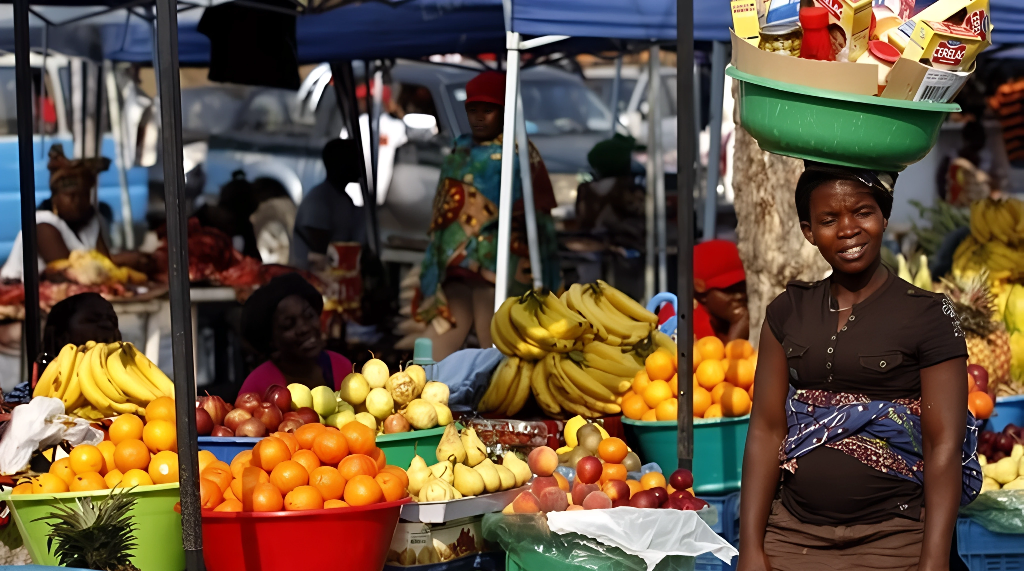
Informality dominates employment across Central Africa, reflecting a persistent structural reality rather than a temporary phase. In Burundi, Chad, the CAR, and the DRC, over 90% of workers operate outside formal systems; even in relatively diversified economies like Cameroon and Gabon, informality remains above 70%. This situation is reinforced by deep institutional and policy barriers, including complex and costly registration procedures, unpredictable taxation, weak contract enforcement, limited access to finance, and inadequate infrastructure that raises operating costs. As a result, most informal activity is survival-driven, with workers trapped in low-productivity sectors such as subsistence agriculture, petty trade, and domestic services. A smaller share represents opportunity entrepreneurship, where micro-entrepreneurs choose informality to avoid rigid regulations or burdensome compliance requirements. Women are disproportionately disadvantaged: 80.7% of female workers are informal, concentrated in sectors characterized by low wages, limited protections, and high vulnerability.
How Inequality and Informality Impede Inclusive Growth in Central Africa
Inequality and informality limit access to opportunities, reduce productivity and social cohesion, and undermine the prospects of inclusive growth. Understanding their impact is essential for developing fairer and more sustainable public policies.
- Economic Growth Without Productivity Gains: One of the striking consequences of persistent inequality and informality in Central Africa is the structurally low labour productivity. Informal workers generally lack access to professional training, finance,and modern technologies, while unequal education access stunts human capital development. In countries like Chad and the CAR, less than half of all children complete primary school with even lower rates among girls. Action hook: Scale vocational training and SME upgrading; target a 10-15% productivity increase in priority value chains within 3 years
- Constrained Domestic Demand: Inequalitiessuppresses household consumption among low-income groups, limiting market depth and excluding women from formal economic participation. Economies remain weak and overly dependent on primary commodity exports and external demand. Action hook: Expand targeted cash transfers and female‑led enterprise financing to boost bottom‑40 household consumption by 15% within 3 years.
- Limited Tax Revenues: Informalityundermines fiscal capacity.. CEMAC’s tax-to-GDP ratio averages under 13%, compared to Africa’s 17% and AU’s 20% target. This fiscal weakness reduces states’ capacity to invest in basic infrastructure. Action hook: Introduce simplified regimes and mobile e tax filing for micro enterprises; aim for a +2 percentage point increase in tax to GDP within 3–5 years.
- Conflict risk: Persistent inequality and exclusion fuel social tensions and political instability, threatening both economic resilience and long-term development prospects. Action hook: Integrate social cohesion metrics into local development plans and fund grievance redress mechanisms; reduce reported local conflict incidents by 5-10% within 3 years.
- An Underutilised Female Potential: The economic exclusion of women represents a clear loss of growth potential. According to the World Bank, reducing gender inequalities in access to labour markets, land and credit could increase GDP by over 10% in several countries in the region. Fully integrating women into the economy would boost resilience, productivity and fairness.Action hook: Expand women’s asset rights, credit access, and procurement quotas; track female‑owned firms’ share in public contracts, aiming for 20% within 3 years, 30% in 5 years.
Policy Recommandations
To reduce inequality and informality and ultimately achieve inclusive growth in the sub-region, the following actions are suggested:
- Scale Up Social Investment: Central African governments must make social investment the backbone of inclusive growth.
What to do:
- Set binding budget floors of at least 15% for education, health, and social protection, in line with UNESCO and Abuja norms.
- Use geo-spatial targeting and equity-weighted transfers to prioritizerural and marginalized communities.
Implementation pathway:
- Anchor spending floors in medium-term expenditure frameworks and national budget laws.
- Establish district-level social spending scorecards published annually.
Targets:
- Education: Raise rural primary completion rates by 10 points in 3 years.
- Health: Increase insurance coverage among informal workers by 15 points in 4 years.
- Formalize Through Inclusion, Not Repression: Formalization must lower barriers, increase incentives, and build trust rather than punish workers and micro-firms.
What to do:
- Introduce digital one-stop shops and zero-fee registration for micro-enterprises (<5 employees) for the first year.
- Adopt presumptive turnover-based tax bands and mobile e-filing.
- Link formalization to tangible benefits: social protection, business services, and access to procurement.
Implementation pathway:
- Launch pilots in two cities per country, then scale nationally within 24 months.
- Offer a non-punitive transition, including temporary amnesty for past non-compliance.
Targets:
- Increase registered micro-enterprises by 25% in 2 years.
- Achieve 50% mobile e-tax filing among micro-taxpayers by year 3.
- Advance Feminist Economic Policy: Gender equality must become a core economic strategy, not a social add-on.
What to do:
- Reform land, inheritance, and commercial laws to guarantee equal titling and collateral rights.
- Extend maternity, health, and childcare benefits to informal women workers.
- Create dedicated credit windows and implement a 30% quota for women-led SMEs in public procurement.
Implementation pathway: Develop national gender-responsive financing frameworks and SME support platforms.
Targets:
- Increase loans to women-led SMEs by 20% within 3 years.
- Raise the share of land titled to women by 15% in 5 years.
- Reach 30% women-led suppliers in procurement within 36 months.
- Strengthen Governance and Regional Integration: Structural reforms will only work with stronger institutions and coordinated regional action.
What to do:
- Upgrade tax administration, statistical systems, and development planning capacities.
- Establish an ECCAS Observatory on inequality and informality, harmonize simplified tax regimes, and develop cross-border infrastructure pipelines.
Implementation pathway:
- Produce annual labour-informality and inequality reports with gender dis-aggregation.
- Adopt regional guidelines for micro-enterprise taxation within 18 months.
- Bring at least two cross-border infrastructure projects to financial close within 24 months.
Accountability: Publish an ECCAS regional dashboard with quarterly country benchmarks.
Conclusion: Acting Now for a Fairer Central Africa
Breaking the inequality–informality trap is the decisive step for Central Africa’s inclusive growth. Governments must now translate ambition into execution by adopting social spending floors, rolling out incentive-based formalization, advancing feminist economic reforms, and strengthening regional coordination anchored in reliable data. Progress should be tracked through measurable gains—higher productivity, broader fiscal space, expanded social protection, and improved opportunities for women and rural populations within a clear 3-5-year horizon. With sustained political will and disciplined implementation, Central Africa can shift toward a more equitable, resilient, and transformative development path.

Dr Vessah Mbouombouo Salim Ahmed
Mr Vessah Mbouombouo Salim Ahmed currently holds a PhD in Development Economics from the University of Yaoundé II-SOA. He holds a research Master II in Monetary and Banking Macroeconomics, and his research interests focus mainly on development economics.

Leave A Comment