
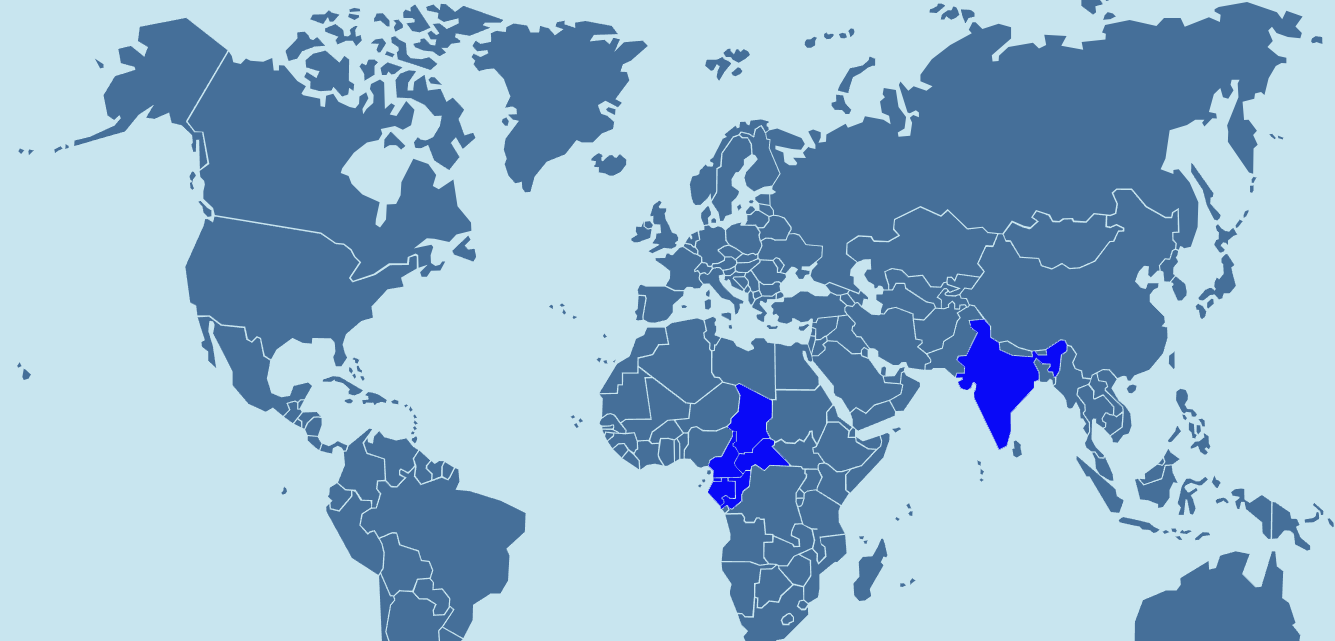
By Dr. ATANGANA Stéphane
INTRODUCTION
Despite significant economic potential, CEMAC countries face structural and institutional challenges limiting sector diversification and competitiveness. Key constraints include inadequate infrastructure, regulatory barriers, limited technological access, and institutional uncertainty, all of which restrict industrial growth and foreign direct investment (FDI) (1).
Trade between India and CEMAC, largely focused on raw materials, particularly crude oil, remains underdeveloped compared to its full potential. Similarly, Indian FDI, mostly resource-driven, is insufficiently utilized. This brief proposes concrete strategies—drawing from endogenous growth and international trade theories—to address these barriers, enhance bilateral cooperation, encourage technology transfers, and promote robust public-private partnerships. Such measures could significantly boost sustainable industrialization and global competitiveness in CEMAC.
ANALYSIS OF ISSUES AND DIAGNOSTIC APPROACH
To analyze trade flows and foreign direct investment (FDI) optimization between India and CEMAC countries, an integrated econometric approach was adopted. This method combines panel data models and time series analysis specific to India to capture both national economic variations and regional trends.
The empirical analysis relies on data sourced from World Development Indicators and includes variables such as GDP, growth rates, trade as a percentage of GDP, net FDI as a percentage of GDP, and industrial value added. These variables were chosen for their significance in assessing the impact of trade and investment on industrial development in CEMAC countries. The theoretical framework integrates endogenous growth models (AK models, Uzawa-Lucas, Romer) and international trade theories, highlighting the interactions between human capital accumulation, technological innovation, and sectoral specialization in fostering regional industrialization.
- Context of Trade Exchanges
Trade between India and CEMAC countries is predominantly focused on commodity exports. Data shows that trade between India and CEMAC countries, particularly Congo, Cameroon, Gabon, and Chad, primarily revolves around raw materials, such as crude oil. For instance, in the first quarter of 2022, crude oil represented 21.04% of Congo’s exports, maintaining its position as the dominant export product throughout the year with market shares ranging from 7.99% to 16.98% (2).
Cameroon’s exports to India mainly include crude petroleum (33.1%), liquefied natural gas (37.4%), and raw cotton (3.4%). Conversely, Cameroon primarily imports diesel fuel (33.1%), semi-milled or milled rice (18.6%), aviation gasoline (9.3%), medicines, and semi-bleached or bleached rice from India (3). Similarly, exchanges between India and other CEMAC nations—Gabon, Chad, etc.—remain concentrated in raw materials such as petroleum, natural gas, manganese, gold, and bauxite (4,5,6,7). These trade dynamics underline CEMAC countries’ heavy reliance on natural resource exports, constraining industrial diversification prospects.
- Foreign Direct Investment Dynamics
FDI from India to CEMAC countries, driven by resource extraction and market expansion strategies, significantly enhances the global competitiveness of Indian firms (8). CEMAC recorded FDI inflows approximating 3.8% of its GDP in 2022, predominantly concentrated in the energy sector (9). These investments extend to sectors that are critical for job creation and technology transfer, including healthcare, manufacturing, and digital technology (10,11).
However, despite substantial FDI flows, current investments are inadequate to overcome structural and institutional barriers limiting industrialization in the region. For instance, exchange regulations established by the Central Bank of Central African States (BEAC) serve both as institutional measures and potential constraints to attracting further investment (12). Thus, addressing these constraints is crucial to optimizing the industrial potential derived from these investment flows.
- Literature Review and Theoretical Framework
This analysis is grounded in endogenous growth models (AK, Uzawa-Lucas, Romer) and international trade theories. Unlike traditional approaches, these models emphasize how government policies and private investments directly influence economic growth through human capital accumulation, technological innovation, and sectoral specialization. (13 ,14,15,16,17,18).
This theoretical perspective provides a strong foundation for evaluating the effects of market integration on innovation and competitiveness. Comparative analysis between India—whose policies have successfully promoted diversification and innovation—and CEMAC countries—still hindered by structural barriers such as inadequate infrastructure and restrictive regulations—highlights critical areas needing reform (19,20, 21).
Consequently, adopting strategies focused on infrastructure improvement, regulatory reforms, technology transfer, and human capital enhancement is crucial for accelerating sustainable industrial growth and reducing regional disparities between India and CEMAC nations.
- Empirical Analysis and Results
To evaluate the dynamics of industrialization, observed and predicted industrial value-added data for India and CEMAC countries were compared. For India, the actual and predicted trends closely align, though some notable deviations suggest the model’s limitations in capturing annual fluctuations. India’s relative stability indicates well-integrated policies and institutional structures. Conversely, data for CEMAC countries show greater volatility, with the model capturing mainly average trends, but not the full extent of observed variability. This difference likely reflects significant structural barriers and frequent external shocks, complicating accurate short-term predictions.
Statistical analyses reveal a robust and positive impact of trade openness (Trade % of GDP) on industrialization for both combined panel data (coefficient ~0.254, p=0.001) and separately for CEMAC (~0.278, p=0.001). However, FDI effects remain insignificant, indicating persistent structural constraints. India’s time-series analysis similarly found no significant influence from trade or FDI on industrial value-added, highlighting the need for additional analytical approaches. Despite substantial Indian investments in strategic sectors, especially oil, gas, and mining, structural issues—such as inadequate infrastructure and rigid regulations—continue to limit the effective industrial benefits from FDI in CEMAC.

Graph I: Comparative trends in industrial value added: observations and predictions (India vs. CEMAC)
- Comparative Evaluation
Comparing India and CEMAC countries highlights significant disparities. India, with strong export diversification in electronics, pharmaceuticals, and engineering sectors (growth rates of 23.64% and 9.67% in specific categories), has become a leader in innovation and global competitiveness. Conversely, CEMAC countries remain limited by commodity dependency, inadequate infrastructure, and restrictive regulations, hindering technological advancement.
Empirical findings indicate that trade openness significantly supports industrialization in CEMAC, whereas the impact of FDI remains constrained by structural barriers. Drawing insights from India’s successful experience, targeted reforms in trade facilitation, institutional regulatory revisions, and active technology transfer are urgently needed. Implementing these strategies is crucial for unlocking CEMAC’s industrial potential and enhancing its global economic integration.
(22).
Table 1: Comparison of Contexts – India vs. Africa
| Factor | India | Africa |
| Trade Policies | India gradually liberalized its economy and foreign trade beginning in the 1990s, stimulating export growth and foreign investment. | African countries also experienced trade liberalization at varying speeds. Many remain heavily reliant on commodity exports, making them vulnerable to global price fluctuations. |
| Investment in Human Capital | India has made significant progress in education and training, although substantial challenges remain regarding access and quality. The ICT sector has been crucial for human capital development. | Africa faces significant challenges in education and health. Limited investment in human capital restricts the continent’s ability to adopt and adapt foreign technologies. |
| Innovation and R&D | India has developed a dynamic R&D sector, notably in ICT, pharmaceuticals, and engineering. Government policies actively promote innovation and technology commercialization. | Africa significantly lags in innovation and R&D due to limited funding, infrastructure, and skills, restricting its ability to innovate and develop new technologies. |
| Institutions | India strengthened its institutions, notably regarding property rights protection and corporate governance. Nonetheless, corruption and bureaucracy remain significant challenges. | Africa faces substantial governance and institutional challenges, including corruption, political instability, and lack of transparency, hindering economic development and investment. |
| Structural Diversification | India successfully transitioned from an agriculture-based economy to one dominated by services and manufacturing. | Many African countries remain heavily dependent on commodity exports, making them vulnerable to external shocks. Economic diversification is crucial for achieving sustainable and inclusive growth in Africa (23). |
POLICY RECOMMENDATIONS
The following recommendations specifically address governmental authorities, investors, customs administrations, and private sector stakeholders to accelerate industrialization and enhance economic competitiveness in CEMAC countries:
Regulatory Harmonization and Customs Facilitation
Simplifying customs procedures and harmonizing regulations will enhance trade openness, market integration, and industrial diversification. Given the significant positive impact of trade openness, this policy will rapidly boost regional competitiveness.
Joint Economic and Industrial Zones
Establishing coordinated joint economic and industrial zones, equipped with adequate infrastructure and incentives, will attract targeted foreign investments and help overcome structural barriers, thereby promoting economic diversification and industrial growth.
Strengthening Public-Private Partnerships
Drawing inspiration from India’s success in innovation, strengthening public-private partnerships will facilitate technology transfer, innovation, and human capital development, creating a resilient industrial ecosystem and sustainable economic growth in the region.
CONCLUSION
The analyses presented demonstrate that, despite considerable economic potential, structural and institutional barriers significantly constrain industrialization in CEMAC countries. Empirical findings highlight the positive impact of trade openness on industrialization, whereas FDI effects remain limited due to structural impediments. India’s experience, marked by successful export diversification and industrial growth through innovation and technology transfer, underscores the necessity for targeted reforms in CEMAC.
Therefore, policy actions must focus on immediate simplification of trade regulations to boost market integration and competitiveness. In the medium term, creating joint economic and industrial zones with adequate infrastructure and incentives will attract targeted FDI. Long-term strategies should emphasize strengthening public-private partnerships, facilitating technology transfer, and investing in skills development to diversify economies and enhance competitiveness.

Dr. Stephane Atangana
Stephane holds a PhD in Economics from the Protestant University of Central Africa (PUCA), in partnership with the Foundation for Studies and Research on International Development (FERDI). He specializes in regional integration, game theory, theoretical and empirical modeling, quantitative and qualitative techniques, matching methods, and econometrics.
His research interests include the provision of regional public goods, economic resilience, and sustainable development.



Leave A Comment