
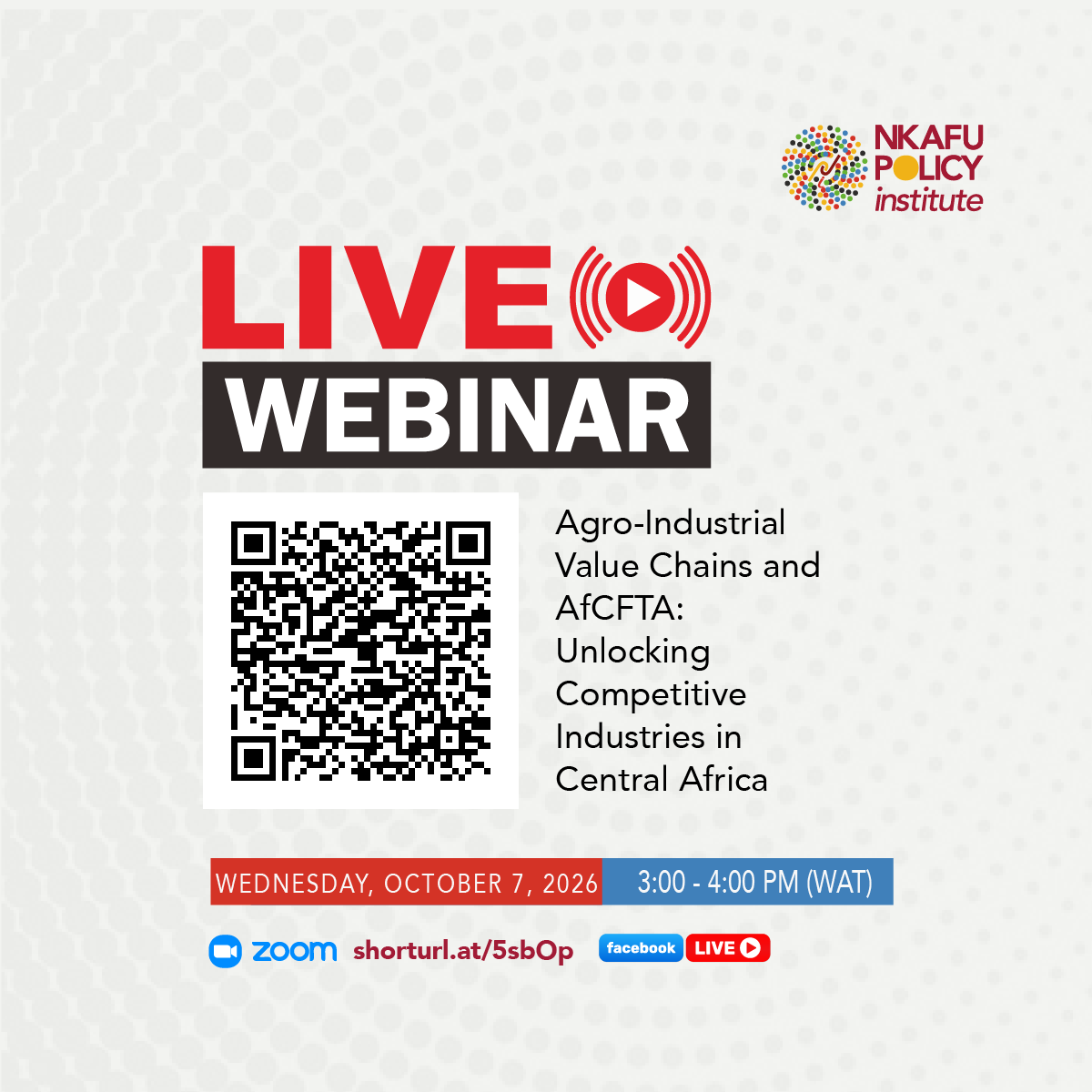
Agro-Industrial Value Chains and AfCFTA: Unlocking Competitive Industries in Central Africa
Date: Wednesday, October 7, 2026
Time: 3:00 – 4:00 PM (WAT)
Venue: Zoom Online (Register Now)
Background and Rationale
Agriculture remains central to livelihoods and economic activity across Central Africa, yet the region continues to capture limited value from its agricultural output. Primary commodities are often exported with minimal processing, leaving countries vulnerable to price volatility, external shocks, and persistent trade deficits. At the same time, Central Africa faces pressing challenges of job creation, industrial diversification, and regional market integration.
The African Continental Free Trade Area (AfCFTA) presents a unique opportunity to reverse these trends by enabling scale, reducing trade barriers, and fostering regional value chains. For Central Africa, AfCFTA can serve as a catalyst for agro-industrialization, linking farms to processing, manufacturing, logistics, and regional markets. By shifting from raw material exports to competitive agro-industries, countries can increase value addition, stimulate private investment, and generate decent jobs—particularly for youth and women.
However, realizing this potential is not automatic. Structural constraints persist, including weak transport and energy infrastructure, limited access to finance, fragmented standards and regulations, skills gaps, and uneven policy implementation. Effective agro-industrial development under AfCFTA will therefore require coherent industrial policy, targeted investments, and stronger coordination among governments, the private sector, regional economic communities, and development partners.
This webinar seeks to examine how Central African countries can strategically leverage AfCFTA to strengthen agro-industrial value chains, enhance competitiveness, and accelerate structural transformation.
Objectives of the Webinar
The webinar aims to:
- Examine the current state of agro-industrial value chains in Central Africa and their role in economic transformation.
- Analyze how AfCFTA can enable scale, market access, and competitiveness for agro-industrial products.
- Identify policy, infrastructure, and financing constraints limiting value-chain upgrading.
- Explore industrial policy options and private-sector strategies to strengthen agro-processing and manufacturing.
- Foster dialogue among policymakers, investors, researchers, and practitioners on actionable pathways forward.
Target Audience
- Policymakers and regulators in trade, agriculture, and industry
- Agribusinesses, SMEs, and private investors
- Development partners and financial institutions
- Think tank researchers and academics
- Civil society and producer organizations
- Students and practitioners interested in regional integration and industrialization
Expected Outcomes
By the end of the webinar, participants are expected to:
- Gain a clearer understanding of how AfCFTA can support agro-industrial transformation in Central Africa.
- Identify priority value chains and policy bottlenecks limiting competitiveness.
- Learn from comparative experiences and practical approaches to value-chain upgrading.
- Strengthen networks among public, private, and regional actors.
- Contribute to evidence-informed dialogue on industrial policy and regional integration.
About the Nkafu Policy Institute
The Nkafu Policy Institute of the Denis & Lenora Foretia Foundation is a leading independent African policy research institution with vision to accelerate Africa’s Economic Transformation. It drives Africa’s prosperity through evidence-informed policymaking, enabling all citizens to thrive in free, fair, democratic, and flourishing economies. Through rigorous analysis, high-impact publications, and inclusive dialogue, Nkafu promotes practical reforms that strengthen governance and enhance Africa’s development trajectory.
Date
- Oct 07 2026
Time
- 3:00 PM - 4:00 PM
Location

Organizer
-
Nkafu Policy Institute
-
Phone
+237 654 86 72 54 -
Email
[email protected] -
Website
https://nkafu.org/ Catalyzing Africa’s Economic Transformation
Leave A Comment