
By Larissa Ntoubia
Executive Summary
Agriculture remains central to livelihoods, food security, and economic diversification in the Central African Economic and Monetary Community (CEMAC), yet its performance remains far below potential. Despite abundant arable land and rising urban demand, weak infrastructure continues to disconnect rural production zones from markets. Poor road networks, inefficient transport corridors, limited storage and processing facilities, unreliable electricity supply, and weak market information systems contribute to high post-harvest losses, elevated transport costs, and persistent food insecurity across the sub-region.
This policy brief examines how infrastructure constraints undermine agricultural productivity and regional trade in CEMAC, drawing on examples from major corridors linking Cameroon, Chad, the Central African Republic, and Gabon. It argues that targeted investments in connective infrastructure particularly rural roads, strategic corridors, cold chains, agro-processing hubs, and digital market systems can significantly enhance market access, reduce losses, strengthen regional integration, and improve food security. The brief concludes with policy recommendations for governments, CEMAC institutions, development partners, and the private sector to unlock agriculture as a driver of inclusive growth in the region.
Key Messages
- Infrastructure deficits are a major constraint to agricultural productivity and food security in CEMAC.
- Poor rural roads and inefficient regional corridors raise transport costs, inflate food prices, and increase post harvest losses.
- Weak connectivity disproportionately affects landlocked CEMAC countries reliant on regional transit corridors.
- Investments in roads, cold storage, agro processing, and digital market systems can unlock agricultural value and regional trade.
- Coordinated infrastructure planning and trade facilitation reforms are essential for transforming agriculture in CEMAC.
Introduction
Agriculture remains central to economic diversification, employment and food security in the Central African Economic and Monetary Community (CEMAC) made up of; Cameroon, Central African Republic, Chad, Equatorial Guinea, Gabon and the Republic of Congo, spread over 3 million km2.. The region is endowed with a diverse climate and substantial land resources with a vast potential for agriculture production and trade. However, this sector remains largely underdeveloped. About 45 percent of the population in the region are facing hunger and malnutrition amid rising prices, with 10 percent experiencing extreme food deficit. Crude petroleum continues to account for 86 percent of CEMAC’s exports, making the economies in CEMAC vulnerable to commodity cycles and fiscal shocks.
Agriculture employs about 47% of the labor force and contributes to approximately 25% of GDP across the region. The sector includes export crops (cocoa, coffee, cotton, oil palm), staple foods (maize, cassava, plantain, rice) and vegetables. As of 2024, economic activities improved moderately; with Cameroon and Chad having strong growth rates stemming from increase in cocoa and cotton exports. Despite favorable conditions, productivity remains low. Also, CEMAC countries still lose about 20% of their food production between harvest and consumption due to weak links between farmers and markets, poor market related infrastructure, and high trade costs due to corruption along key corridors. Poor rural roads increase transport costs, delay the delivery of perishable goods, and increase post-harvest losses. The lack of storage capacity and irregular electricity supply limit agricultural processing, forcing farmers to sell their products at low prices directly from their farms. Agriculture in the region therefore has high potential but low performance.
The objective of this policy brief is to examine how infrastructure constraints undermine agricultural productivity and regional trade in CEMAC. It identifies priority investment and policy recommendations for governments, regional institutions and development partners to strengthen market integration and food security.
I. Current Infrastructure Constraints Hindering Agricultural Potential in CEMAC
i. Road Infrastructure Deficits: A Structural Bottleneck
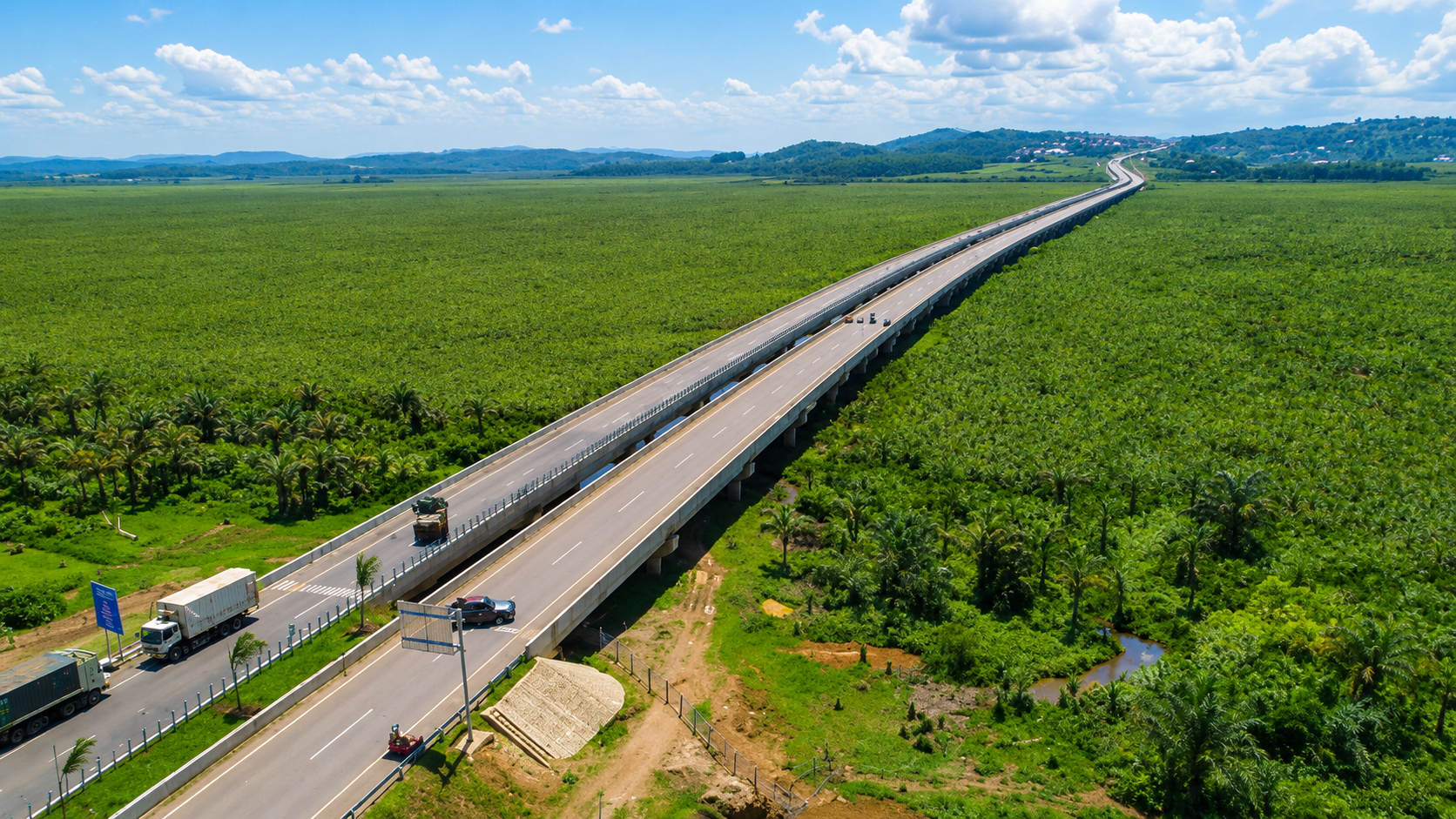
Road density in CEMAC is very low with about 1.9 km of road per 100 inhabitants, with paved roads representing only 0.24 km per 100 inhabitants, the region falls significantly below Sub-Saharan African averages. Although the total road network in the sub region spans about 57,858 km, only about 12 percent was paved as of 2022, and delays in maintenance have since affected overall quality. Rural roads that are essential for field to market linkages are mostly unpaved and frequently impassable during rainy seasons. In the Far North region of Cameroon, between 28 and 35 percent of rural urban transport flows are disrupted seasonally. Short distance transport from farms to markets accounts for 15–25 percent of production costs, reflecting both deteriorating road surfaces and vehicle overload on fragile roads.
The consequences of these infrastructural deficits are immediate and costly, with post-harvest losses of up to 30 percent for perishable commodities such as tomatoes and leafy vegetables which reduces farmers income. Producers in western Cameroon, notably around Foumbot, experience significant value erosion as trucks navigate potholed routes towards Douala. Similarly, northern producers transporting goods to Garoua face elevated spoilage and transaction costs. Landlocked Member States, particularly the Central African Republic and Chad, which depend on Cameroon as their maritime gateway, are even more exposed to the corridor’s inefficiencies.
ii. Corridor Inefficiencies and Regional Fragmentation
CEMAC’s three principal regional transit corridors illustrate the depth of the connectivity challenge. The Douala–N’Djamena Corridor, serving Chad through Cameroon, remains highly constrained, with only about 20% of roads in Cameroon and 6% in Chad paved and passable year-round. Poor road conditions, excessive checkpoints, and seasonal flooding near Kousséri–N’Djamena increase delays, damage perishable goods, and inflate costs, with companies incurring up to CFA 2.2 million in informal fees per trip.
Similarly, the Douala–Bangui Corridor, linking Cameroon to the Central African Republic, suffers from severe pavement degradation, with only about 48 percent in good condition. The problem seems to lie in the neglect of road quality by Cameroon as only 30 percent of the Cameroonian section in the Douala-Bangui corridor is in good condition, against 100 percent of the Central African section. Informal payments and border harassment add 7–14 percent to final prices, while political instability further disrupts trade flows. Across both corridors, high transport costs and post-harvest losses are transmitted along the value chain reducing farmer profits, weakening market access, and driving up consumer prices.
The Libreville–Douala Corridor, connecting Gabon and Cameroon through Abang-Minko-Eboro, reflects similarly compounded inefficiencies. Informal charges from 44 checkpoints total about CFA 1.5 million with unofficial customs fees and delays reaching up to 15 hours per trip. Transport costs remain high due to inadequate paving, constraining the flow of goods between both countries. These inefficiencies limit Cameroon’s vegetable exports to Gabon, increase the cost of processed imports.
II. Infrastructure Solutions
Addressing infrastructure constraints in CEMAC requires a well defined approach that combines immediate, high impact interventions with longer term strategic investment..
Short-Term Interventions
Cold chain development to stabilize prices is equally primordial. Power shortages spike volatility; solar powered cold storage along corridors can preserve perishables like tomatoes and leafy greens. Post-harvest losses represent one of the most significant but under-addressed constraints in CEMAC’s agriculture. Perishable commodities such as tomatoes, onions, leafy vegetables, and fruits often experience of up to 20 percent due to inadequate storage and unreliable electricity.
These losses translate into income instability for farmers and price volatility for consumers. Developing solar powered cold storage units offer a financially viable and environmentally sustainable option in regions with limited grid reliability. Evidence from pilot projects across sub-Saharan Africa indicates that modular cold storage facilities can reduce post-harvest losses by 25 to 40 percent and increase farmer revenues by enabling delayed sales during higher-price periods.
Furthermore, information asymmetry continues to disadvantage smallholder farmers. Limited access to real-time price data, weather forecasts, and buyer information weakens farmers’ bargaining power and perpetuates inefficiencies in the supply chain. Mobile-based market information systems, electronic payment solutions, and digital extension services have been shown to increase farm incomes by improving price transparency and reducing transaction costs.
Medium-Term Investments
Strategic road rehabilitation on priority corridors is very important. Rehabilitating high impact corridors like Douala-Bangui and Libreville-Douala will offer high returns. Paving unpaved segments would cut transport time by 30% and digitalization corridors by improving on truck GPS services will reduce informal fees by 14%.
Also, establishing agro-processing clusters near production zones can significantly enhance value retention within member states. Agro-processing has increased commodity value in countries like Ethiopia and Tanzania. Therefore, investments in rice milling, cassava processing, palm oil refining, fruit drying, and livestock processing would not only reduce post-harvest loss and import dependency but also generate employment opportunities in rural areas.
III. Policy Recommendations and Conclusion
Despite agriculture’s promise, infrastructure deficits in CEMAC exacerbate vulnerabilities. Limited rural electrification and poor road quality isolate farmers from markets, while under investment in irrigation infrastructure heightens exposure to droughts and floods. Economic pressures, including volatile commodity prices and high input costs, further strain the sector, mirroring broader issues in low-income contexts. To address these, policymakers should prioritize:
- Infrastructure Development
CEMAC governments and institutions should target high return connectivity linking farming zones to urban and regional markets by expanding road, and investing in improved drainage systems to avoid floods along major corridors. Prioritize the Douala-Bangui corridor, where Cameroon Development Corporation (CDC) estimates improvements could cut travel times by 25% and logistics costs 15-20% for transit firms, unlocking agro-potential for smallholders.
- Energy and Storage Systems
Governments and development partners should integrate renewable energy particularly solar-powered cooling across the agri-food supply chain, from farm-level storage to regional transport corridors like Douala-Bangui. This will enhance consumer trust in perishable quality and boost financial institutions confidence in lending to climate resilient agricultural ventures.
Also, the government could leverage PPPs to build warehouses, cold chains, and agro-processing hubs along corridors like Libreville-Douala. Drawing from experience from the Northern Corridor successes (EAC), where solar cold storage reduced vegetable losses of about 35%, stabilizing prices for cross-border trade.
- Trade Facilitation and Corridor Governance
Custom officials should simplify trade and transport rules to reduce delays and costs. Target a 14% reduction in informal fees through mandatory GPS truck tracking and digital checkpoints.
- Digital Agriculture and Market Systems
The government through service providers should expand mobile connectivity in rural areas and integrate digital tools such as adding digital apps to farmer training services. This will modernize farm markets, give real-time prices, and help farmers handle climate shocks like droughts on Douala-Bangui roads.
Conclusion
Enhancing CEMAC’s agricultural potential requires good infrastructure. Without connective infrastructure; the combination of road access, cold storage, processing facilities, and information systems, production gains will continue to be undermined by inefficiencies and post-harvest losses. Targeted investments in the region can transform agriculture into a driver of regional integration, food security, and inclusive economic growth.

Larissa Ntoubia
Ntoubia Ngapmen Larissa, holds a Bachelor’s degree in Banking and Finance and a Master’s degree in Economics and Financial Engineering from the University of Yaoundé II Soa. She is currently a Research Associate at the Nkafu Policy Institute of Denis and Lenora Foretia Foundation under the Economic Affairs Division.



Leave A Comment