
By Anthony Antem
Executive Summary
The recent adoption of the United Nations Declaration recognizing the transatlantic slave trade as a crime against humanity marks a historic milestone in global acknowledgment of historical injustice. For Africa, this recognition must serve not as an endpoint, but as a strategic entry point toward substantive reparatory justice. Moving forward, the Africa Union must align historical justice with contemporary development priorities to reframe reparations not merely as compensation, but as a mechanism for structural redress, including debt relief, technology transfers, institutional investments, and cultural restitution. Of prime importance, the AU must establish dedicated institutional frameworks, such as an African reparations task force or special envoy, to coordinate advocacy at multilateral platforms, including the United Nations General Assembly (UNGA). Finally, the brief also recommends leveraging strategic partnerships with the African diaspora, civil society, and Global South allies to amplify Africa’s negotiating power and moral authority.
Policy Highlights
- Spanning the 15th to 19th centuries, the transatlantic slave trade displaced about 12.5 millionAfricans, causing lasting demographic loss, institutional disruption, and sustained
- UNGAhas officially recognized transatlantic slave trade as “gravest crime against humanity”
- This recognition marks a strategicwindow of opportunity for the continent to advance reparative justice and to shape emerging global agendas
- The African Unionmust adopt a unified continental position on reparations and establish a dedicated task force or special envoy on reparations.
Introduction
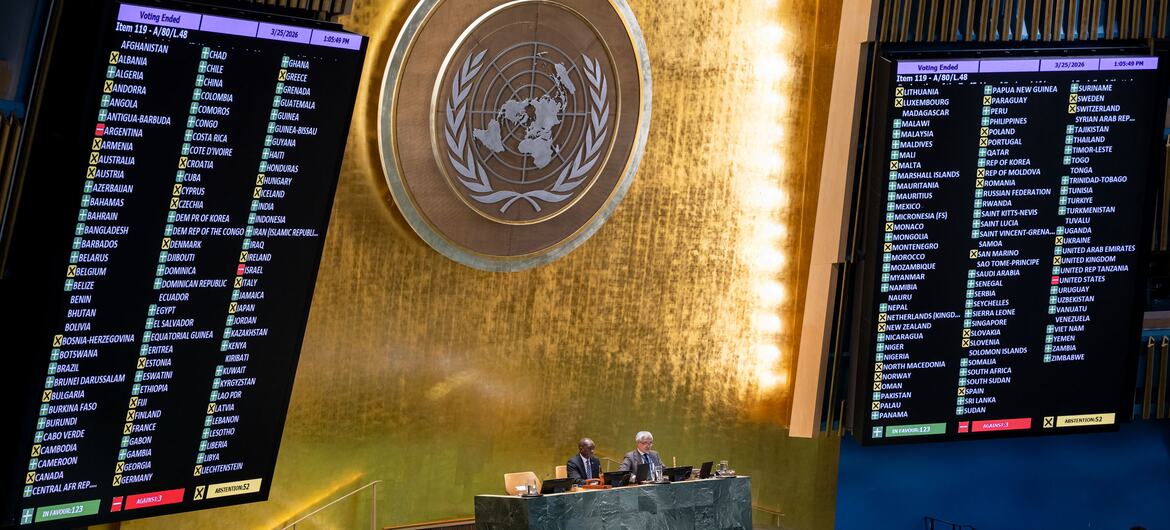
Introduced by Ghana on March 25, UNGA passed a landmark resolution, that seeks to advance reparatory justice for the trafficking of enslaved Africans and the radicalized chattel enslavement of Africans. Beyond its immediate human toll estimated at atleast 5 million persons, the trade facilitated the extraction of labor and resources that underpinned the economic rise of Western economies while weakening state formation and social cohesion across Africa. Through its thematic framing “Justice for Africans and People of African Descent Through Reparations”, as the 2025 theme of the year, the African Union continues to articulate Africa’s position by advocating for reparatory justice, restitution of cultural heritage, and a re-balancing of global economic relations to address historically rooted inequalities. This stance aligns with a broader and intensifying global discourse on reparatory justice and systemic inequality, where scholars, policymakers, and civil society actors increasingly link past injustices such as slavery and colonialism to present-day disparities in wealth, development, and global power structures, thereby reinforcing calls for comprehensive and sustained redress mechanisms. This policy brief argues that Africa must act now to seize this strategic opportunity. Failure to do so could mean missing a crucial moment to advance reparative justice and influence emerging global agendas on equity and reform. This policy brief aims to examine how the African Union can translate the United Nations Declaration on the Transatlantic Slave Trade into a coordinated continental strategy for reparatory justice, using diplomatic, institutional, and economic policy instruments
I-Why this recognition matters for Africa’s strategic positioning
The recognition of the transatlantic slave trade as a crime against humanity presents a strategic window for Africa to consolidate diplomatic leverage on the global stage, particularly through coordinated action within the African Union specialized mechanisms. This moment can be harnessed to push beyond symbolic acknowledgment toward concrete economic justice and development outcomes, including calls for debt restructuring, targeted investments, and equitable access to technology and global markets. At the same time, it offers a renewed platform to strengthen Africa-Diaspora engagement, transforming shared historical experiences into a foundation for strategic partnerships in trade, innovation, and cultural exchange. By aligning diplomatic influence with economic priorities and diaspora collaboration, Africa can reposition reparatory justice as a catalyst for sustainable development and global equity.
II-What should constitute reparative justice for the African continent
- Financial Instruments
Establish reparation funds, concessional financing, and development compacts to support infrastructure, social services, and climate resilience under African Union coordination.
- Investment and Trade Instruments
Create dedicated investment funds, preferential trade agreements, and public–private partnerships to drive industrialization and reduce aid dependency.
iii. Cultural Restitution Mechanisms
Use bilateral agreements, legal claims, and continental registries to accelerate the return of looted artifacts and strengthen cultural sovereignty.
- Education and Knowledge Instruments
Expand scholarships, research funding, and institutional partnerships to build human capital and promote equitable knowledge exchange.
- Diaspora Policy Instruments
Introduce dual citizenship frameworks, diaspora bonds, and mobility agreements to enhance diaspora participation in development.
- Technology Transfer Mechanisms
Promote technology-sharing agreements, industrial partnerships, and skills development programs to strengthen local capacity and innovation.
III- Policy Pathways: How can Africa leverage this recognition for its strategic interests
Short-Term (0–6 months)
- Adopt a Continental Reparations Framework
The African Union should adopt a unified framework defining Africa’s position, priorities, and negotiation red lines. Immediate actions include convening a high-level summit, mandating a technical working group, and aligning the framework with Agenda 2063.
- Establish a Legal and Institutional Mechanism
Set up a dedicated reparations commission or appoint a special envoy to lead implementation. Priority steps include conducting legal audits, consolidating evidence, and preparing engagement with international platforms such as the International Court of Justice and the United Nations.
Short to Medium Term (6–18 months)
- Operationalize Financial and Development Instruments
Launch an African Reparations Fund, concessional financing windows, and blended investment vehicles through existing continental financial institutions. Focus on co-investment models, debt swaps, and targeted sector financing.
- Institutionalize Diaspora Engagement
Adopt dual citizenship policies, issue diaspora bonds, and create formal channels for diaspora participation in AU processes. Prioritize regulatory reforms and investment facilitation mechanisms.
- Scale Education and Cultural Diplomacy Initiatives
Expand scholarship programs, support curriculum reforms, and strengthen advocacy for cultural restitution through multilateral platforms such as UNESCO. Use these as quick-win measures to build momentum and global support.
Conclusion
The recognition by the United Nations of the transatlantic slave trade as a crime against humanity should be understood as a strategic opening rather than an endpoint. It presents Africa with a critical opportunity to shift from symbolic acknowledgment to coordinated, structured, and sustained collective action. To fully capitalize on this moment, the continent, through the African Union, must translate historical recognition into concrete policy, diplomatic, and economic initiatives that advance reparatory justice. Ultimately, the broader objective is not only to address historical wrongs, but also to strengthen global equity and contribute to more inclusive and sustainable development outcomes for Africa and its diaspora.

Antem Anthony
Anthony is a Head of Conflict Prevention, and Analysis Unit at the Foretia Foundation. Prior to joining the Foundation, he served as conflict, policy and security assistant at the International Crisis Group, Kenya.


Leave A Comment