
Introduction
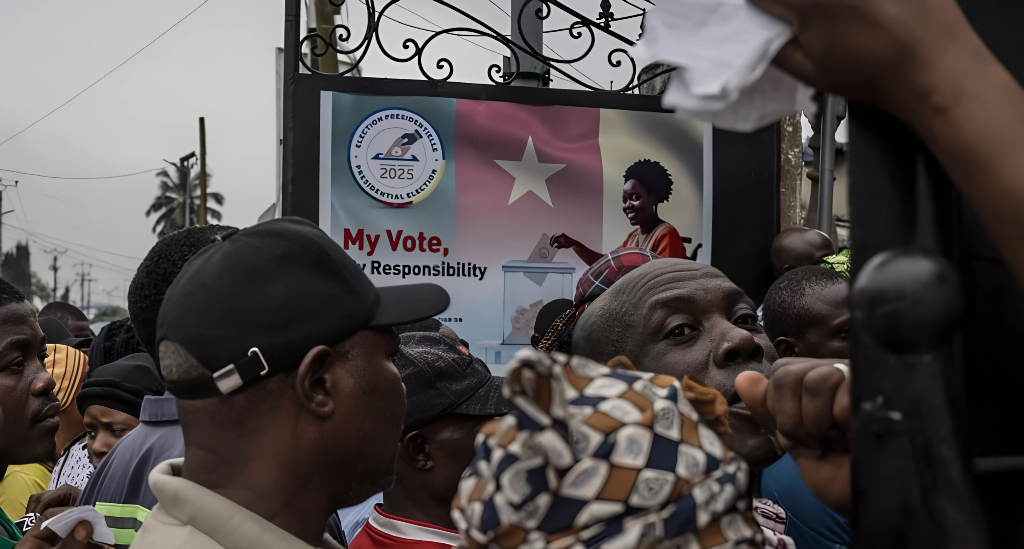
Weeks after Cameroon’s 2025 presidential election, the dust is yet to settle on an election described by 9 members of the US Congress as a “serious erosion of democratic norms”. Between numerous killings, arbitrary arrests of peaceful protesters and opposition figures, kidnappings, looting and destruction of property, the post electoral scenario in Cameroon did not fall short of expectation as early indicators highlighted the risk of a polycrisis in Cameroon. Away from the violent scenarios recorded, it would be of benefit to the enlarged public and policy makers to take note of some positive scenarios which were equally observed throughout this election and how multisectoral actions can shape positive outcomes for the community. In view of informing best practices locally and internationally, this article therefore highlights some key lessons from Cameroon’s just ended elections
Voter education’s potential to shrink voter apathy
While the Elections Management Board, ELECAM acknowledges its inclusive system with stakeholders to ensure that every eligible voter has the opportunity to participate in electoral processes, civil society organizations in the vast majority have championed the cause for voter education through a multitude of civic engagement platforms. Despite logistical challenges reported and difficulties for voters to acquire voter’s cards, ELECAM still recorded over 8 million registered voters. In sharp contrast to the popular narrative that citizens have no interest or deliberately avoid participating in political processes due to predictable outcomes, the figures announced by ELECAM rather translate to a growing interest by the public to meaningfully participate in electoral processes despite the odds. It is now expected for CSOs in particular and stakeholders at large to sustain their tailored approaches towards civic engagement in view of upcoming municipal and legislative elections for a more inclusive, transparent and effective outcome of the electoral processes.
Social media as a vector for transparency and accountability
Away from the court rooms, social media has increasingly emerged as a popular stage for the administration of justice and equity especially due to its user-friendly capacities and more importantly, its accessibility by the public.
In a context where political transparency and accountability remain subject of wider debate, the public, led in the majority by voters, took advantage of social media to provide regular updates on trends and patterns from all aspiring candidates and institutions concerned with the electoral process. While cyber-criminality as a whole remains a huge fight, the presidential election particularly witnessed cases of misinformation, disinformation and AI-generated fake news. Despite these, the positive influence of social media was felt on election day and more specifically at the polling stations where counting and declaration of results led to short terms predictions on who led the race to become president of the republic.
Far from the experiences of previous years, voters of the 2025 presidential elections held tight to their mobile devices, ready to film the entire voting process to ensure they kept track of all that transpired at the polling stations. In reality, some of the recordings from these polling stations served valuable in informing the public and relevant authorities on electoral malpractices even if nothing proves that complains were actually taken into account. By way of illustration, a woman was caught attempting to insert multiple CPDM ballot papers into the ballot box before being caught in Mutengene, SW Region. In Douala, Littoral Region, the President of a polling station was caught falsifying reports in favour of President Biya; In the Northern Regions, the mayor of Garoua 2 was caught attempting to stuff the ballot box with CPDM ballot papers; In the West Region, an ELECAM official received a slap for alleged fraud, while in Muea, SW Region of Cameroon, ELECAM officials carried the ballot box away after voting ended, denying to count votes on the pretext of having received “orders from above”; still in Bonamoussadi, Littoral Region, an ELECAM official was spotted falsifying results late at night and in an undisclosed locality, ELECAM officials were spotted in a classroom-like structure, falsifying results in the presence of uniformed men.
The relevance of social media was even further felt when opposition leader now self-declared winner, Issa Tchiroma Bakary, used is social media account to publish what is believed by a majority of the population as true and credible results from the ballot boxes.
No need for an opposition coalition
Defeating President Biya’s CPDM in an election has proven extremely difficult and almost impossible for any politician/political party that single handedly attempted to do so in the past presidential elections. With President Biya emerging winner of the just ended Presidential elections, it even appears further impossible to the average Cameroonian for President Biya to lose an election. Prior to the start of presidential campaigns, popular narrative suggested that, only a strong and united coalition of influential political parties could defeat President Biya. This hope was nursed by 9 out of 10 Cameroonians as the magic wand that could finally bring about the much-sought political alternation. For the first time ever witnessed, salient attempts were made by opposition parties to form a united and strong coalition with each these attempts ending with dispersed camps failing to agree on a single candidate to represent the bloc. Local media even pointed that the opposition was nothing short of greedy, self seeking and lacking clear sense of direction.
To crown it all, Jeune Afrique Media described the Cameroonian opposition as the dumbest in Africa for amongst others, «entertaining egoistic politicians, ideological divisions and fighting amongst themselves rather than unite to fight against a common enemy». Inspite of these, contested outcome of elections reveal that forming a coalition for future presidential elections would not only suffer little acceptance from the public but may in essence, not be necessary to win an election or to the least, defeat President Biya
Against all odds, some politicians have proven that elections can be genuinely won by being closer to the people at campaign grounds, translating public concerns and worries into concrete political projects and manifestos, paying particular attention, recognizing and addressing issues of public concern and being dynamic enough in communication to appeal to a diverse audience.
Existing legal frameworks – the constitution and electoral code need urgent reform
The 2025 presidential elections revealed once again the lapses of cameroon’s elections management body ELECAM and the Constitutional Council, widely criticized for lacking independence from the executive. Beyond the pre-requisite to depoliticize both operational instances, urgent reforms needed include:
- Institutional Independence triggered by an end to presidential appointments of members of ELECAM. A realisitic, inclusive and effective approach would necessitate a pluralistic appointment of members of ELECAM and the Constitutional Council by a multitude of actors such as parliament, the judiciary, civil society and resource persons from the private sector or business ecosytem to guarantee credibility of the electoral process. Furthermore, legal provisions need to be adopted to prohibit officials affiliated to political parties from serving on both instances to avoid conflicting interests.
- A revision of mandates and term limits of members of the Electoral Board and General Directorate of Elections.In actual circumstances, the mandate of these members expire under unforeseen circumstances which altogether promote electoral hold up, favoritism and political manipulation. The introduction of non-renewable fixed terms for members and commissioners appears therefore indispensable to ensure the dynamism and credibility of the electoral process.
- Improved transparency and accountability: From an operational/procedural standpoint, a mechanism for disclosure of administrative decisions, procurement, and results – management procedures need to be fully made public by ELECAM at all operational/technical levels and through out the entire electoral process. Such reform would not only promote transparency but eliminate ambiguities, curb media propaganda/fake news and serve valuable in informing public opinion in view of ensuring firm compliance of all actors throughout the electoral process.
Security forces can be republican
Against popular belief that security forces are anti-republican and accustomed perpetuators of violence and human rights violations, the 2025 presidential election highlighted rare scenarios where security forces demonstrated exceptional professional conduct lauded by civilians and authorities. In contradiction to public demonstrations witnessed in the aftermath of past elections wherein security forces were frontline perpetrators of violent crackdown, intimidation and arbitary arrests, video excerpts specifically highlighted scenarios where security forces refrained from perpatrating violence but rather providing counsel and guidance to protesters thereby laying to rest years of debate on the quality of training provided to security forces. While these scenarios alone do neither absolve Cameroon’s security forces from past cases nor do they exempt them from professional misconduct, it highlights the need to promote civil-military dialogue in view of enhancing social cohesion between civilians and the security sector.
To further guarantee the credibility and effectiveness of security forces ensuring they align with constitutionally defined republican values, it is imperative for reforms to be undertaken to suppress partisan affiliation/allegiance in order to ensure strict compliance of the security sector to constitutionally backed legal frameworks and not political elites, government authorities, influential businessmen and high ranking military officials. Such a reform wields the potential to avoid instrumentalisation of the security sector for malicious or political gains.
Conclusion
Understanding that national electoral processes are quite determinant in defining key orientations for a country, it remains largely unpredictable for observers and analysts to determine with certainty, outcomes from each election due to a variety of conflicting interests, illicit electoral manoeuvres and operational defiances. In fact, recent presidential elections in some countries across Africa have been faced with challenges of electoral integrity and political manipulation. Even though outcomes may not be acceptable to a vast majority of the population, this is not sufficient ground to entirely jeopardize the electoral process. Based on observations raised above, key recommendations include;
- The urgency to immediately depoliticize ELECAM and the Constitutional Council. To guarantee institutional independence and stability, a constitutional provision must be defined and adopted by Parliament to ensure members of both instances are selected from clearly defined factions of the community and must not be affiliated to any political parties. These members must be allocated a fixed 5 year mandate renewable once.
- Progressive digitization of the voting process to eliminate electoral malpractices associated with voting lists and ballot boxes, curb ambiguities in policy frameworks and institutional decisions. The success of such a novel process would require instant political will and progressive logistical action to ensure full coverage, coherence and effetiveness across the national territory to promote inclusion, transparency and authenticity of the electoral process.
- Allocation of absolute financial autonomy to election management organs (ELECAM and the Constitutional Council). Rather than allocating funds for these organs through the Ministry of Territorial Administration, it is more credible for the elections management organs to own an independent operational budget. This reform must be carried our prior to the next legislative and municipal, and subsequent elections to ensure limited executive and government interference into the operationalization of the mandated organs.



Leave A Comment