
Introduction and Background
Over the years, the United States Agency for International Development (USAID) has been very instrumental in combatting extreme poverty, promoting resilient democratic societies, and advancing socio-economic development globally. In doing this, it contributes to advance its security and prosperity via foreign aid that promotes national security by helping to combat conditions that can spawn terrorism – such as poverty, weak institutions and corruption. It realizes this by promoting economic development, good governance and transparency in foreign countries (including African countries), thereby helping to safeguard the security and prosperity of the United States. USAID is important because it contributes to sustainable development that helps in creating stronger economies in Africa and other less-developed regions worldwide. A rundown of USAID impact around the world includes protecting the Amazone rainforest, fighting cocaine in South America and engaging in disease response, girls’ education and free school lunches in Africa. Last year, the US gave the Sub-Saharan African region more than 6.5 billion dollars in humanitarian assistance [1]. It has supported marginalised communities from the Balkans to Uganda, the media in Myanmar and mine clearance in Cambodia. In Africa alone, publication by the US embassy, reveals that since 2021, the US has committed to providing nearly US$20 billion in health programmes. In all, the US dedicates approximately 70% of its annual aid budget to health programs in Africa, totaling around $5.6 billion [2]. Following Donald Trump’s enthronement to power, there have been drastic cuts in USAID funding through the signing of more than 50 executive orders affecting other areas domestically and abroad [3]. Most important for Africa is his move to cut US development assistance and reduce efforts to combat corruption, HIV/AIDS, tuberculosis, and other communicable diseases – which, to a considerable extent, will have some overarching effects on Africa’s health system. Anchored within the paradigm of the politics of development assistance, this article proposes to tease out some of the burning issues that resonate from the drastic cuts of USAID funding within Africa’s healthcare system. The rest of the article is structured as follows: Part two presents a summary of USAID cuts and their impact on global development. It proceeds to analyse its impact on Africa’s healthcare system, and section three presents some groundbreaking recommendations and strategies for the future of Africa’s healthcare system.
A Summary of USAID Cuts and Its Impact on Africa’s Development
With the enthronement of Donald Trump at the helm of the US presidency, more than 50 executive orders have been signed, including that which stipulates the reduction in USAID funding globally. This has been sad news particularly for Africa, which over relies on US financial assistance in combating HIV/AIDS, improving the capacity of healthcare workers, building healthcare structures, and engaging in the fight against other communicable diseases and corruption.
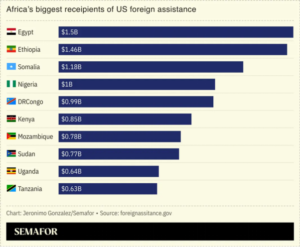
The USAID started giving out notices of suspension and instructing recipients to stop working on awards and not incurring any new cost following Donald Trump’s executive order of re-evaluation and re-alignment on US foreign aid. Subsequently, emergency food assistance and the administrative cost required to manage such aid were excluded by a 90-day waiver as it involved life-saving humanitarian relief to many countries, including Chad, Central Africa Republic, South Sudan, DR Congo, Rwanda and Uganda [4].
The US is by far the world’s largest source of foreign assistance, financing projects in some 120 countries across the globe aimed at combatting diseases, educating children, providing potable water, and enhancing other areas of development [ibid]. According to Madan Keller (a policy fellow and deputy director of Global Health Centre for Global Development), the “stop-work order has upended many of those projects and has seen nurses laid off and clinics closed in more than 25 countries where two-thirds of all child deaths occur globally [5].”
Effects of Funding Cuts on Africa’s Healthcare System
According to Aron Motsoaledi (South African Minister of Health), the US freeze on aid has a debilitating effect on South Africa’s healthcare sector, the country with the highest incidence of people living with HIV in the world. He reiterated that the US finances 20% of the $2.3 billion required yearly to manage South Africa’s HIV/AIDS program through PEPFAR. As it stands, the biggest response to a single disease in history is under threat [6].
In the case of Cameroon, the USAID has been a major player in boosting several health programs, especially in areas such as maternal and child health, infectious diseases (including HIV/AIDS and malaria), and health system strengthening. The potential reduction of USAID funding can have lasting effects on the country’s healthcare system. Some of the possible effects of funding cuts include reduced access to services, challenges in the healthcare workforce, supply chain disruptions, and an increased burden on the government [7]
Likewise, the reduction of USAID funding can significantly affect healthcare systems in Africa in diverse ways. One such way is through decreased financial resources. A decrease in USAID funding will affect basic healthcare initiatives such as infectious disease control, including maternal and child health. Also, it can lead to program disruptions or discontinuation, thus stifling access to significant healthcare services. Furthermore, it will affect disease control initiatives. Since USAID has been a significant actor in financing initiatives for HIV/AIDS, malaria, tuberculosis and other communicable diseases, a reduction of funding in this regard can hinder the progress made in controlling these diseases, possibly leading to higher levels in morbidity and mortality rates [8].
Another effect of funding cuts revolves around health equity issues, healthcare infrastructure, global partnerships, and human resource challenges. Regarding issues on health equity, susceptible populations, including women, children, and sidelined communities, may be excessively affected by funding cuts, leading to increasing health gaps. Likewise, a reduction in funding can affect healthcare infrastructure. USAID frequently boost this sector through the building of clinics, training healthcare personnel, and enhancing the supply chain for medications and vaccines. A reduction in funding can disrupt these programs, leaving healthcare amenities under-equipped and dependent on obsolete practices. The majority of healthcare personnel in Africa are trained via funding provided by the USAID. Funding cuts can lead to fewer opportunities for training and professional development, aggravating existing shortages of skilled healthcare employees [9].
In addition, funding cuts can be detrimental to global health partnership building, as they might affect collaboration with other international agencies and NGOs involved in addressing health issues in Africa. Funding cuts may also affect long-term sustainability mechanisms, as over-reliance on external funding can affect the development of sustainable healthcare strategies in African countries. Next, we present some recommendations that can help policymakers [10].
Recommendations and Strategies
- There is a need for advocacy and policy adjustments. Interested parties can advocate for policies that prioritize healthcare financing in the national budget.
- It is advisable for African countries to start exploring alternative sources of funding, generally and precisely within the healthcare sector. This may include embarking on domestic revenue generation, public-private partnerships, and involvement with other international donors.
- African governments should also strive towards efficiency by enhancing the effectiveness of existing healthcare initiatives that can help moderate some impacts of funding reduction.
Conclusion
This article aimed at addressing the impact of funding reduction on Africa’s healthcare system. It acknowledges the significance of USAID in combatting extreme poverty and promoting resilient democratic societies across the globe. The ascendancy of the Trump administration at the helm of power has affected USAID flows through one of his executive orders. Thus, the reduction of USAID is likely to have profound implications on the healthcare systems in Africa, and concerted efforts will be needed to address these challenges effectively.

Dr Fuein Vera Kum is a Research Fellow at the Nkafu Policy Institute. She joined the institute as Economic Policy Analyst in 2017 with a focus on health economics and development policy. She holds a Ph.D in Economics from the University of Benin, Nigeria.

Leave A Comment