
By Salim Ahmed Vessah
Executive Summary
Infrastructure expansion in Central Africa has accelerated over the past two decades, largely driven by Chinese financing and construction. While this trend has helped reduce physical bottlenecks in transport, energy, ports, and telecommunications, it has also entrenched a development model characterized by high foreign control, limited domestic value creation, and growing market concentration. Beyond the well-documented dominance of Chinese state-owned enterprises (SOEs), the current challenge lies in how ownership structures, weak local content outcomes, and fragile regulatory capacity interact to constrain long-term economic transformation. Using recently available project-level and sectoral data and country-level examples from Cameroon, Congo, Gabon, and the Democratic Republic of the Congo, this policy brief shows that infrastructure delivery in Central Africa increasingly reproduces dependency rather than fostering industrial upgrading. It argues that without a strategic recalibration such as linking infrastructure to industrial policy, enforcing local content, and strengthening regulatory institutions, Central Africa risks locking itself into a low-learning, low-ownership equilibrium. The brief concludes with phased policy recommendations to restore bargaining power and developmental agency.
Key Messages
- Chinese SOEs dominate strategic infrastructure across Central Africa, particularly in transport, energy, ports, and telecommunications.
- Local economic gains remain limited, with domestic firms capturing less than 20% of major contract values and benefiting little from technology transfer.
- Weak regulatory capacity reduces governments’ bargaining power and limits local content outcomes.
- The key challenge is no longer financing infrastructure, but capturing greater ownership and value from it.
- Stronger local content policies, better governance, and regional coordination are critical for turning infrastructure into a driver of industrialization and economic transformation.
Introduction: Moving Beyond a Known Problem
The growing dominance of foreign actors in African infrastructure is widely acknowledged in policy and academic debates. What distinguishes the current phase in Central Africa, however, is not simply the presence of external financiers and contractors, but the systemic concentration of control over the entire infrastructure value chain. Infrastructure in the region has evolved from a collection of physical assets into a strategic arena where financial leverage, technological standards, data flows, logistics networks, and long-term revenue streams are negotiated and, increasingly, consolidated by a narrow set of actors. This shift has profound implications for economic sovereignty, industrial learning, and market structure. Central Africa remains the least integrated and least industrialized region on the continent. Manufacturing contributes less than 10 % of GDP in most Economic Community of Central African States (ECCAS) countries, while intra-regional trade remains below 6 %, far behind other African blocs. High logistics and energy costs continue to undermine competitiveness: The African Development Bank estimates that infrastructure bottlenecks raise production costs in Central Africa by 30-40 %, discouraging private investment and reinforcing dependence on primary commodities. These structural constraints coexist with an estimated USD 25-30 billion annual infrastructure financing gap, creating strong incentives for governments to prioritize rapid project delivery over long-term developmental considerations.
Against this backdrop, Chinese engagement has expanded rapidly. Between 2000 and 2022, Chinese entities committed over USD 40 billion to infrastructure projects in Central African countries, accounting for more than 70 % of large-scale construction contracts in key sectors. Unlike traditional development partners, Chinese state-owned enterprises (SOEs) often operate through bundled, vertically integrated arrangements that combine finance, construction, equipment supply, and, in some cases, operation and maintenance. While this model accelerates infrastructure delivery, it also reshapes market dynamics, limits competitive entry, and reduces opportunities for domestic capability building. The critical issue today is therefore not whether Chinese SOEs dominate infrastructure, but how this dominance interacts with weak regulatory capacity to shape ownership patterns, learning opportunities, competition, and long-term economic agency in Central Africa. Unlike previous assessments that focus on debt or project delivery, this brief integrates political economy, market structure, and industrial policy perspectives.
Dominance of Chinese SOEs in Roads, Ports, Dams, and Telecoms
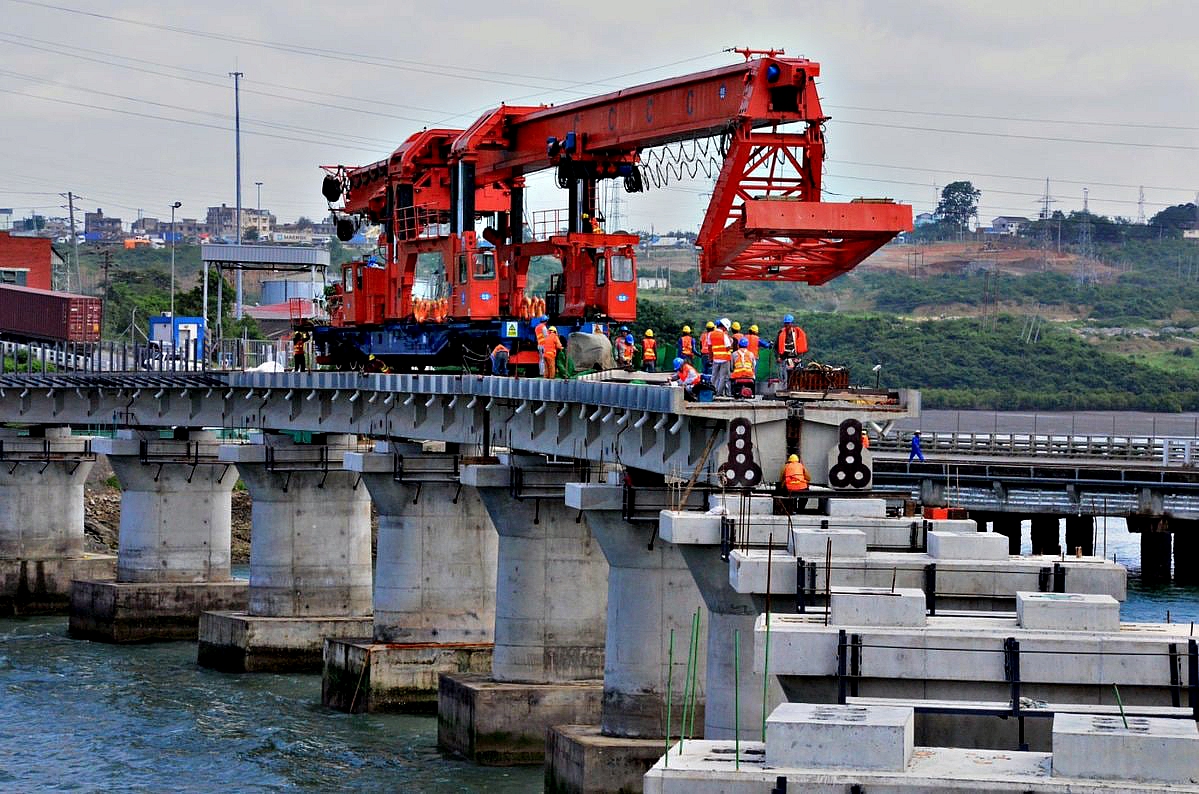
Chinese SOEs dominate virtually all strategic infrastructure sectors in Central Africa. In transport, Chinese firms account for an estimated 65-80 % of major road and highway projects in Cameroon, Congo, and the DRC. In Cameroon alone, more than 1,500 km of roads have been constructed or rehabilitated by Chinese companies since 2010. Port infrastructure illustrates the depth of this control. The Kribi Deep Sea Port in Cameroon, one of the most strategic logistics hubs in Central Africa was financed, constructed, and partially operated by Chinese SOEs. Similarly, the Pointe-Noire corridor in the Republic of the Congo has been expanded through Chinese-backed port, rail, and road investments, consolidating Chinese presence along the entire logistics chain. According to the energy sector, Chinese firms dominate hydropower development. In the DRC, Chinese companies are involved in large hydropower projects linked to mining corridors, while in Cameroon they built key dams such as Memve’ele, which increased national generation capacity by nearly 20 %. Telecommunications follow the same pattern: Chinese firms have built national fiber-optic backbones in several Central African countries, often under government-to-government financing arrangements. These projects are typically delivered through vertically integrated contracts, where the same firm finances, builds, equips, and sometimes maintains the asset. While this accelerates delivery, it severely limits competition and locks governments into long-term technical and financial dependence.
Local Contractor Participation and Skills Transfer: Limited Spillovers
Despite the scale of infrastructure investment, local economic spillovers remain weak. Across Central Africa, local firms capture less than 20 % of total contract value in large infrastructure projects, and and are largely confined to low-value activities such as earthworks, transport, and security services. Employment outcomes are similarly constrained. In major road and dam projects in Cameroon and Congo, local workers account for 60-70 % of total employment, but less than 10 % of skilled technical positions. Project management, engineering design, and equipment maintenance remain overwhelmingly dominated by expatriate staff. Skills transfer mechanisms are often informal and poorly monitored. Although contracts frequently include training clauses, these are rarely linked to certification, technology absorption, or long-term employment pathways. As a result, once projects are completed, domestic firms and workers are unable to replicate or scale similar projects independently. By contrast, countries such as Morocco and Egypt have used infrastructure investment to deliberately build domestic engineering and construction champions. Central Africa’s failure to do so reflects not only foreign dominance, but also weak policy coordination between infrastructure planning, vocational training, and industrial development.
Regulatory Capacity of Central African States: A Structural Weakness
Regulatory capacity is the critical missing link in Central Africa’s infrastructure story. Most Central African countries lack specialized units capable of negotiating complex infrastructure contracts, assessing long-term fiscal risks, or enforcing competition rules. According to the World Bank’s Country Policy and Institutional Assessment (CPIA), Central African countries score below the African average on public-sector management and regulatory quality. Competition authorities are either absent or weak, and infrastructure regulators often lack independence and technical expertise. This institutional fragility creates asymmetrical bargaining power. Governments negotiate with large SOEs that possess superior financial, legal, and technical capacity. Contract opacity further undermines accountability: in several cases, details of repayment terms, operational control, and maintenance obligations are not publicly disclosed. At the regional level, Central Africa lacks a coordinated infrastructure governance framework. Unlike ECOWAS or EAC, it has no effective mechanism to harmonize procurement standards, pool expertise, or jointly negotiate with external partners. This fragmentation reduces collective leverage and reinforces dependency. While Central Africa lacks a unified infrastructure governance framework, some regional mechanisms exist; however, they remain fragmented and weakly enforced. Initiatives such as the CEMAC transport corridors, the PDCT-AC, and the PIDA provide partial coordination for cross-border infrastructure. Nevertheless, these mechanisms suffer from limited institutional capacity, weak enforcement of common standards, and insufficient technical expertise. Strengthening Central Africa requires the development of a regional procurement framework, the pooling of negotiation expertise, and the establishment of a permanent infrastructure coordination and monitoring unit.
Opportunities: Reclaiming Agency in Central Africa’s Infrastructure Landscape
Despite the structural challenges associated with foreign dominance, the current infrastructure landscape in Central Africa presents significant but underexploited opportunities. The scale of ongoing investments in transport, energy, ports, and digital infrastructure offers a window for Central African countries to leverage infrastructure delivery as a platform for learning, industrial upgrading, and institutional strengthening, rather than treating it as a purely transactional exercise. First, the presence of large, technically sophisticated foreign SOEs creates opportunities for learning-by-doing, provided governments embed enforceable capability-building objectives into contracts. Infrastructure projects in hydropower, logistics, and telecommunications involve transferable engineering and project-management skills. With clear training, certification, and joint-venture requirements, these projects can accelerate the emergence of domestic construction and engineering capacity.
Second, the concentration of infrastructure delivery underscores the potential of regional coordination within Central Africa. Acting collectively, member states could harmonize procurement standards, local content rules, and technical expertise, strengthening bargaining power and supporting cross-border infrastructure aligned with regional value chains. Third, infrastructure expansion can serve as an anchor for industrial policy. When linked to industrial zones, agro-processing hubs, and SME development, infrastructure can drive diversification rather than extraction. Finally, the global shift toward green and resilient infrastructure presents an opportunity for Central Africa to attract climate finance and reposition itself as a strategic partner in shaping investment terms, provided that governance frameworks are strengthened.
These opportunities are not automatic; they depend on deliberate policy choices, institutional reform, and regional cooperation. However, they demonstrate that the current infrastructure model, while constrained, also contains the building blocks for a more autonomous and transformative development trajectory.
Policy Recommendations: A Phased Strategy
Short Term (1-2 years): Regaining Control and Transparency
- Publish 100% of new large-scale infrastructure contracts and financing terms by 2026, drawing on transparency practices in Ghana and Senegal.
- Enforce minimum local content thresholds of ≥60% local employment and 20-30% local subcontracting value in all public infrastructure projects.
- Establish dedicated infrastructure negotiation units within finance and planning ministries, staffed with legal, financial, and engineering experts.
Medium Term (3-5 years): Building Domestic Capability
- Strengthen local content laws to require certified skills transfer, training over 500 engineers and technicians per country by 2028, linked to vocational and engineering institutions.
- Promote competitive procurement by unbundling finance from construction in at least 30% of new projects, following Morocco’s model.
Long Term (5-10 years): Structural Transformation
- Establish an ECCAS-led Regional Infrastructure Governance Platform by 2035 to harmonize procurement, competition, transparency, and local content standards across Central Africa.
- Support the emergence of 2-3 regional construction and engineering champions, aligning infrastructure investment with industrial policy, export diversification, and regional value chains.
Conclusion: From Infrastructure Delivery to Economic Agency
Central Africa’s infrastructure boom has improved connectivity but has not yet translated into structural transformation. The core challenge is no longer access to finance or construction capacity, but who controls infrastructure and for what developmental purpose. Without stronger regulatory institutions, enforced local content, and strategic alignment with industrial policy, infrastructure risks deepening dependency rather than enabling transformation. Reclaiming economic agency requires moving beyond project-by-project delivery toward a systemic approach that prioritizes ownership, learning, and competition. Infrastructure must become a tool for building domestic capabilities, not merely a physical asset financed and controlled from abroad. The choices made today will determine whether Central Africa’s infrastructure underpins long-term development or entrenches structural vulnerability.

Dr Vessah Mbouombouo Salim Ahmed
Mr Vessah Mbouombouo Salim Ahmed currently holds a PhD in Development Economics from the University of Yaoundé II-SOA. He holds a research Master II in Monetary and Banking Macroeconomics, and his research interests focus mainly on development economics.




Leave A Comment