Governance

Beyond Symbolism: Can an Anglophone Vice President redefine Governance in Cameroon?

By Antem Anthony|2026-04-20T16:04:53+00:00April 20th, 2026|Categories: Peace & Security, Publications|Tags: , |

By Anthony Antem Executive Summary This brief examines the proposition of appointing an Anglophone Vice President in Cameroon and interrogates whether such a move would transcend symbolic inclusion to meaningfully reshape governance. Situated within [...]


Strengthening Democracy, Deepening Practice, and Shaping the Future of Governance in Central Africa

By Dr. Pippie Hugues|2026-01-28T10:27:48+00:00January 28th, 2026|Categories: Governance & Democracy Initiative, Publications|Tags: , , |

By Dr. Pippie Hugues Executive summary Democracy in Central Africa is at a critical juncture. While citizen demand for accountability has grown, political instability, fragile institutions, and shrinking civic space continue to undermine democratic [...]

Central Africa’s Governance Crisis: Structural Constraints and Policy Options

By Antem Anthony, Enowbachem Agbortanyi and Muriel Mesette Kinkoh|2025-12-24T08:03:53+00:00December 23rd, 2025|Categories: Peace & Security, Publications|Tags: , |

By Antem Anthony, Enowbachem Agbortanyi and Muriel Mesette Kinkoh Context Central African countries such as the Central African Republic, Democratic Republic of the Congo, Chad, Cameroon, Republic of the Congo, Gabon, and Equatorial Guinea, despite being resource-rich and strategically placed countries, [...]

Enhancing Think Tanks and CSOs’ Resilience in the Governance Ecosystem

By Ayukmba Nkonghonyor|2025-07-29T11:27:27+00:00July 28th, 2025|Categories: actions, ESLP blog post, forum|Tags: , |

Surveys from the past half‐decade in Cameroon and the Central African Republic have found that between 60% to 70% of registered NGOs report experiencing heightened administrative delays, licensing obstacles, or harassment by government authorities. [...]

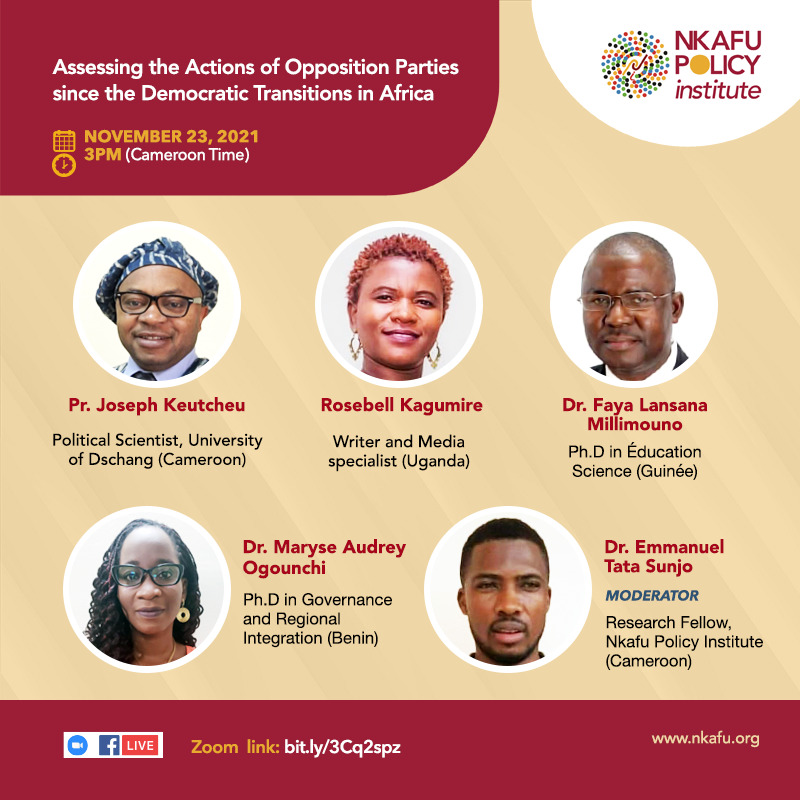
Assessing the Actions of Opposition Parties since the Democratic Transitions in Africa

By TALLA Belder Carynthon|2022-01-11T08:57:38+00:00November 4th, 2021|Tags: , , , |

The factors of this degeneration of the opposition are multiple: organisational weakness; pre-eminence of individualistic interests over national interests; leadership syndrome; inexistence or scarcity of political programmes; collusion with the party in power; messy coalitions, etc.

Go to Top