
By Fabien Sundjo, Ph.D
Policy Context
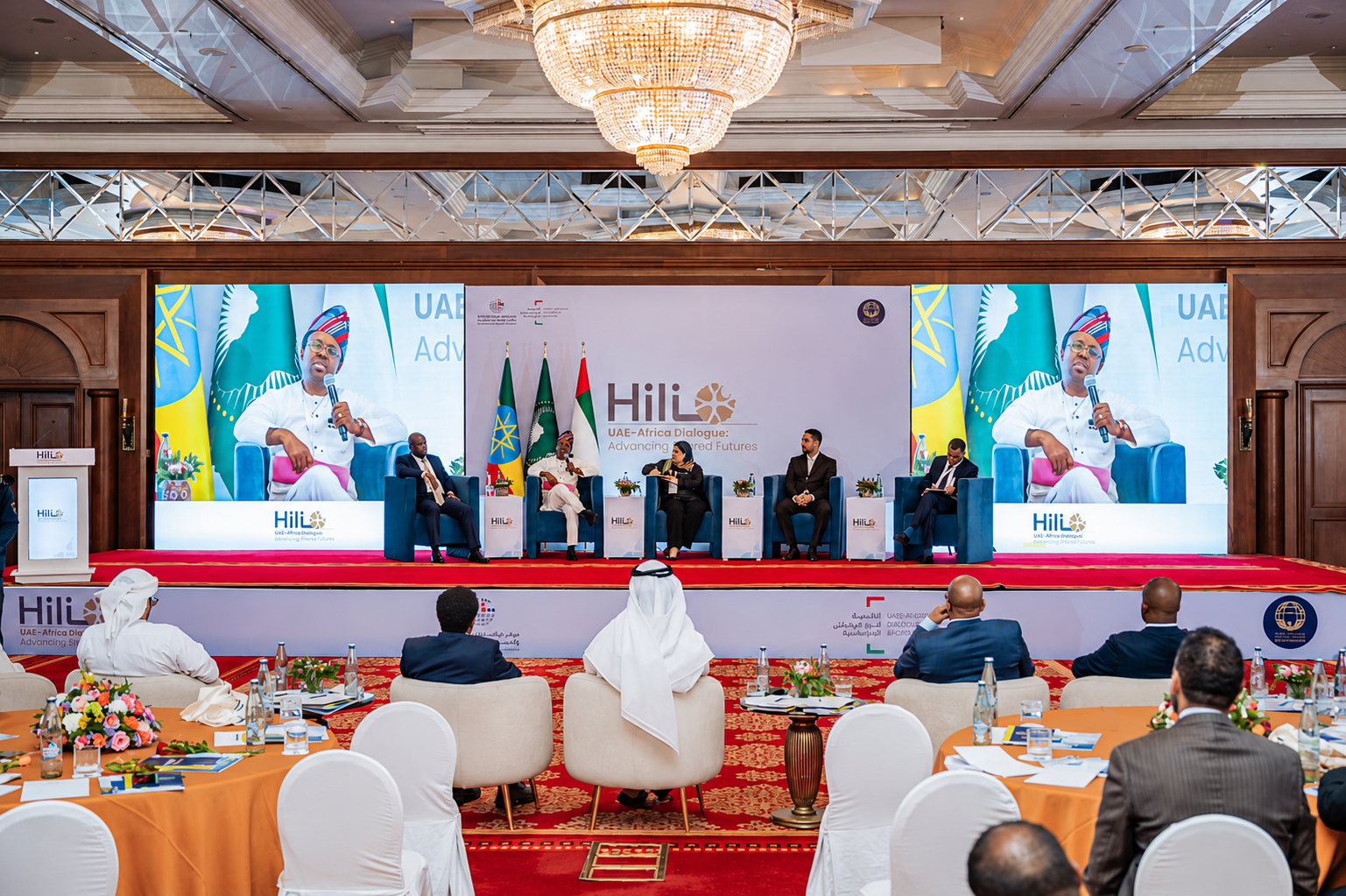
This policy brief draws on the expert intervention of Dr Fabien Sundjo, Senior Economist and Research Fellow in Economic Affairs at the Nkafu Policy Institute of the Denis and Lenora Foretia Foundation and the University of Bamenda, during the Hili Africa Dialogue 2026, organised by the United Arab Emirates. Fabien Sundjo participated as an invited panellist in the high-level session entitled “Strategic Synergies: Economic Transformation and New Trade Partnerships,” where leading policymakers and development experts examined how emerging partnerships between Africa and the United Arab Emirates (UAE) can accelerate industrialisation, regional integration and sustainable economic transformation.
The panel was moderated by Dr Damyana Bakardzhieva, Senior Research Fellow at AGDA (United Arab Emirates), and brought together distinguished experts including H.E. Amb. Alfred K’Ombudo, Senior Advisor on Trade Policy and Commercial Diplomacy to the President of Kenya; Tariq Al Suwaidi, Director of the New Economy Department at the UAE Ministry of Economy and Tourism; Dr Melaku Geboye Desta, Acting Director of the Regional Integration and Trade Division and Coordinator of the African Trade Policy Centre at the United Nations Economic Commission for Africa (UNECA); and Dr Fabien Sundjo, representing the Denis and Lenora Foretia Foundation.
Rather than reproducing the panel discussion, this policy brief synthesises the principal policy arguments advanced by Fabien Sundjo during the dialogue and complements them with current empirical evidence to propose practical policy options for strengthening UAE-Africa economic cooperation.
Introduction
The relationship between Africa and the United Arab Emirates has evolved rapidly over the past decade, moving well beyond traditional diplomatic engagement towards strategic economic cooperation. Today, the UAE is among Africa’s leading foreign investors, with substantial investments in ports, logistics, renewable energy, agriculture and digital infrastructure. According to the United Nations Conference on Trade and Development (2024), the UAE has emerged as one of the largest sources of foreign direct investment into Africa, while trade between the two partners continues to expand steadily. At the same time, the implementation of the African Continental Free Trade Area Secretariat (2024) offers Africa an unprecedented opportunity to develop integrated regional markets capable of supporting industrialisation and competitive regional value chains.
During the panel discussion, one central argument guided my intervention: Africa’s greatest opportunity does not lie in exporting more raw materials, but in producing more value from those resources before they leave the continent. For decades, many African economies have relied on exporting unprocessed commodities while importing finished goods at considerably higher value. Although this model has generated export earnings, it has delivered only limited industrial development, insufficient employment creation and weak technological progress. The challenge is therefore no longer attracting investment alone, but ensuring that investment contributes directly to productive transformation.
This policy brief builds upon the policy positions presented during the Hili Africa Dialogue 2026 and argues that the next phase of UAE-Africa cooperation should move decisively from resource extraction towards industrialisation, technology transfer, innovation and human capital development. The analysis is intended for African governments, UAE policymakers, development finance institutions, regional organisations, private investors and development practitioners seeking practical pathways for building more productive and mutually beneficial economic partnerships.
Drawing on the perspectives shared during the panel, together with evidence from recent international policy reports, the policy brief first examines why the current cooperation model requires rethinking before proposing strategic policy actions capable of transforming trade partnerships into engines of industrial development across Africa.
From Commodity Exports to Value Addition: Why the Next Phase of UAE–Africa Cooperation Must Build African Industries
One of the central messages I advanced during the panel discussion was that Africa’s comparative advantage should no longer be measured by the quantity of raw materials it exports, but by the value it creates before those resources leave the continent. This distinction is fundamental because, for decades, Africa has participated in global trade largely as a supplier of primary commodities while importing higher-value manufactured products. Although this model has generated foreign exchange earnings, it has produced relatively little industrialisation, limited technology transfer and insufficient employment opportunities for Africa’s rapidly growing population.
The statistics are compelling. According to the United Nations Conference on Trade and Development (2024), manufactured goods account for less than one-fifth of Africa’s merchandise exports, while most countries continue to rely heavily on exports of crude oil, minerals and unprocessed agricultural commodities. Consequently, a significant proportion of the economic value generated from African resources is captured outside the continent through processing, manufacturing and branding.
During the Hili Africa Dialogue, I argued that the future of UAE-Africa cooperation should therefore be assessed not by the volume of investment committed but by the extent to which that investment expands Africa’s productive capacity. Foreign direct investment undoubtedly remains essential for financing infrastructure and supporting economic growth. However, investment alone does not automatically translate into development. Sustainable transformation occurs when investment strengthens domestic industries, creates skilled employment, transfers technology and integrates local enterprises into regional and global value chains.
Agriculture illustrates this opportunity particularly well. Africa possesses nearly 60 per cent of the world’s remaining uncultivated arable land, yet much of its agricultural production continues to be exported with minimal processing. Meanwhile, the UAE has established itself as a global leader in logistics, food distribution and international supply-chain management. Rather than continuing the traditional model of exporting raw cocoa, coffee, cotton or cashew nuts, future cooperation should prioritise joint investments in agro-processing industries capable of producing finished products for African, Middle Eastern and international markets. Such an approach would retain greater value within African economies while creating higher-income employment and expanding export competitiveness. This argument aligns closely with recommendations advanced by the African Development Bank (2024), which emphasises agro-industrialisation as one of the continent’s most promising pathways towards structural transformation.
A similar opportunity exists within renewable energy and critical minerals. Africa possesses abundant reserves of lithium, cobalt, manganese and rare earth minerals that are indispensable to the global energy transition. At the same time, the UAE has become an increasingly important investor in renewable energy through institutions such as Masdar. Yet exporting raw strategic minerals while importing finished batteries, electric vehicles and renewable-energy technologies would simply reproduce historical patterns of dependency. As emphasised during the panel, the objective should instead be clear: mine in Africa, process in Africa and manufacture in Africa. This shift would allow African economies to capture a much larger share of global value chains while strengthening industrial resilience.
Ultimately, the success of future UAE-Africa cooperation should not be measured solely by investment volumes or trade statistics, but by whether these partnerships create competitive industries, expand productive employment and position Africa as an active participant in global manufacturing rather than a passive supplier of raw materials.
From Investment to Transformation: Building Industrial Ecosystems for Shared Prosperity
A second argument I emphasised during the panel was that Africa does not simply require more investment; it requires investment that deliberately builds productive ecosystems. Across the continent, roads, ports and power plants have expanded considerably over the past decade. However, infrastructure alone rarely transforms an economy unless it is integrated with manufacturing, innovation, logistics and local enterprise development. The next phase of UAE-Africa cooperation should therefore focus on creating complete industrial ecosystems rather than financing isolated projects.
This requires a shift towards three mutually reinforcing priorities. First, every major investment should include clear commitments to local value addition and technology transfer. Capital is important, but knowledge creates lasting competitiveness. Joint ventures should therefore incorporate technical training, research partnerships, apprenticeship programmes and support for local suppliers. According to the World Bank (2024), countries that combine foreign investment with skills development and technological learning are more likely to achieve sustained industrial growth than those relying solely on capital inflows.
Second, industrial cooperation should be aligned with the opportunities created by the African Continental Free Trade Area (AfCFTA). Rather than viewing Africa as fifty-four separate markets, investors should increasingly develop regional value chains that serve the continental market. Industrial parks linked to transport corridors, logistics platforms and export-processing zones can significantly reduce production costs while expanding market access for African firms. Such an approach would strengthen the competitiveness of both African enterprises and UAE investors operating across the continent.
Third, the partnership must place human capital at its centre. During the discussion, I argued that Africa’s most strategic resource is not cobalt or lithium, but its young population. By 2050, Africa is expected to possess the world’s largest labour force. Yet this demographic advantage will translate into prosperity only if accompanied by sustained investments in technical education, vocational training, digital skills, entrepreneurship and innovation. Every strategic investment should therefore leave behind not only physical infrastructure but also a stronger base of engineers, technicians, entrepreneurs and innovators capable of sustaining industrial development long after individual projects have ended.
The future of UAE-Africa relations should therefore be measured not by the number of agreements signed but by the productive capacity jointly created. Partnerships that generate local industries, competitive enterprises and skilled employment will contribute far more to Africa’s long-term economic transformation than those centred exclusively on commodity exports. In this respect, the relationship should evolve from one based primarily on commercial transactions towards one founded on shared industrial development, technological cooperation and inclusive prosperity.
Conclusion and Policy Recommendations
This policy brief examined how the next phase of UAE-Africa economic cooperation can move beyond traditional investment towards genuine industrial transformation. Building on the policy perspectives I presented as an invited panellist during the Hili Africa Dialogue 2026 under the session Strategic Synergies: Economic Transformation and New Trade Partnerships, the paper argued that Africa’s long-term prosperity will depend less on the volume of foreign investment it attracts than on the productive capacity that such investment creates.
The analysis drew upon the key arguments advanced during the panel discussion and complemented them with evidence from recent international policy reports. It demonstrated that while the UAE has become one of Africa’s most important economic partners, future cooperation should increasingly focus on strengthening regional value chains, promoting technology transfer, supporting industrial ecosystems and investing in human capital. Such an approach would allow African economies to retain more value from their natural resources, generate quality employment and improve their global competitiveness.
The discussion suggests that the future of UAE-Africa relations should be guided by a “Value Addition First” Partnership Compact, under which major investments in agriculture, mining, renewable energy and strategic industries include measurable commitments to local processing, manufacturing, technology transfer and enterprise development. Equally important is the establishment of a UAE-Africa Skills and Innovation Alliance, bringing together governments, universities, technical institutes and the private sector to strengthen vocational education, research collaboration, entrepreneurship and digital innovation. Sustainable partnerships are ultimately built not only on infrastructure and finance but on the capabilities of people.
As I concluded during the panel discussion, the future of Africa-UAE cooperation should not be defined by the quantity of raw materials exported or the value of investment agreements signed. It should be judged by the industries created, the technologies transferred, the enterprises strengthened and the opportunities generated for African citizens. The transition from extraction to industrialisation is not simply an economic choice; it is the foundation upon which a more resilient, competitive and mutually beneficial Africa-UAE partnership can be built.

Dr. Fabien SUNDJO is a Research Fellow in Economic Affairs at the Nkafu Policy Institute. He holds a Ph.D. in Health and Development economics, obtained under the auspices of the African Economic Research Consortium Nairobi (AERC)

Leave A Comment