

By Dr Salim Ahmed Vessah & Dr Hugues Pippie
Executive Summary: CEMAC is facing a significant crisis that threatens the stability of the monetary union and economic integration in Central Africa. By the end of 2025, member states’ arrears to the Commission reached CFAF 263.5 billion, primarily due to a low execution rate of the Community Integration Tax (CIT) at only 60%. This has led to the suspension of non-essential activities, hindering financing for regional projects and macroeconomic coordination. The region also faces low trade integration (2-5% of intra-CEMAC trade), high budget deficits, and heavy reliance on oil revenues, increasing vulnerability. The inability to mobilize reliable resources undermines institutional effectiveness and investor confidence. To restore CEMAC’s credibility and enhance regional integration, it is crucial to improve CIT collection and management through digitization and transparency; establish a regional fiscal stabilization fund; clarify institutional mandates and strengthen economic coordination; and promote intraregional trade by eliminating non-tariff barriers and investing in cross-border infrastructure. These measures can transform the current crisis into an opportunity for sustainable reforms, ensuring financial stability, institutional autonomy, and effective economic integration.
Key Messages
- The CEMAC crisis reflects major weaknesses in regional governance and fiscal coordination.
- Low Community Integration Tax collection has undermined the financial autonomy and effectiveness of CEMAC institutions.
- Heavy dependence on oil revenues and weak macroeconomic coordination increase regional vulnerability to external shocks.
- Digitizing Community Integration Tax collection and strengthening transparency are essential to restore institutional credibility and investor confidence.
- Regional financial stability requires stronger institutions, fiscal reforms, and deeper economic integration.
Introduction
The Central African Economic and Monetary Community (CEMAC) is undergoing an unprecedented institutional and financial crisis. Created in 1994 with the aim of consolidating regional economic integration based on a common currency (the CFA franc) and a shared central bank (BEAC), the union is now at a critical turning point. This crisis is manifested not only by macroeconomic tensions, but also by the practical collapse of its community financing mechanisms. At the end of 2025, member states’ arrears to the Commission reached 263.5 billion CFA francs, according to a report presented to the Community Parliament in Malabo and relayed by the Gabonese Press Agency (AGP). This situation stems largely from the low collection rate of the Community Integration Tax (CIT), which was created primarily to support the Community budget. While 51.9 billion CFA francs were expected in 2025, only 31.09 billion were collected, representing an execution rate of less than 60%.
This imbalance has resulted in an inability to finance the Commission’s operations, to the point that its president, Baltasar Engonga Edjo’o, announced on February 5th, 2026, the temporary suspension of non-essential activities and missions in order to preserve remaining liquidity. The consequences go beyond mere administrative dysfunction: they call into question the credibility of CEMAC, the stability of the CFA franc, the attractiveness of the region to investors, and its ability to pursue economic integration. Faced with these challenges, it is essential to thoroughly rethink regional governance by strengthening institutions, modernizing fiscal mechanisms such as the ITC, improving macroeconomic coordination, and mobilizing own resources to finance structural projects. This policy brief analyzes the roots of the crisis, assesses the risks for the region, and proposes a set of actionable recommendations.
Why this moment matters: Strategic context
The CEMAC comprises six Central African countries (Cameroon, Chad, Congo, Gabon, Equatorial Guinea, and the Central African Republic) using the CFA franc, managed by the Bank of Central African States (BEAC). The monetary union has led to disappointing results, with intraregional trade accounting for only 2% to 5% of total trade, one of the lowest levels in Africa. In contrast, other regional groupings, like the East African Community (EAC) and the Southern African Development Community (SADC), have internal trade exceeding 18%, aided by harmonization policies and trade facilitation initiatives. The CEMAC faces limited market integration, weak industrial coordination, and a lack of common strategies for developing regional value chains. Despite the common currency, national economic policies prevail, undermining the effectiveness of regional instruments and hindering a truly integrated market.
- Macroeconomic pressures and financial vulnerabilities
The CEMAC zone faces significant economic vulnerabilities. Regional growth is modest, estimated at 2.8% in 2025, insufficient for job creation and improving per capita prosperity amidst rapid population growth. Economies in the zone rely heavily on oil and mining exports, exposing public finances to global commodity price fluctuations and increasing fiscal volatility. Budget deficits are high, and public debt often exceeds 70% of GDP in several member states, limiting responses to external shocks and reducing public investment capacity. Regional macroeconomic coordination is weak, with poorly implemented and insufficiently binding surveillance mechanisms. Additionally, ineffective collection of the Community Integration Tax (CIT) undermines funding for the CEMAC Commission. These issues increase vulnerability to external shocks, undermine monetary stability, and limit essential structural projects for economic integration and diversification.
Key issue: governance shortcomings behind the suspension
The suspension of CEMAC’s institutional activities is not an isolated incident; it reflects deep structural deficits in the design and implementation of regional governance.
The institutional architecture of CEMAC is characterized by overlapping bodies with sometimes redundant mandates, without a sufficiently strong supranational authority to enforce common commitments and rules. Coordination between the Commission, BEAC, and member states lacks clarity, leading to inefficiencies in policy planning and execution. Budgetary surveillance and convergence mechanisms are often declarative rather than binding: the convergence criteria, which are supposed to guarantee common budgetary discipline, do not have sufficiently robust sanction or incentive mechanisms to ensure effective compliance.
One of the main failures observed is the low effectiveness of fiscal convergence criteria. In periods of high oil revenues, some member states exceed budget ceilings without incurring any real sanctions. Conversely, in periods of external shocks, states adopt pro-cyclical fiscal policies, exacerbating economic fluctuations rather than mitigating their effects. The absence of a regional fiscal stabilization mechanism makes the area particularly vulnerable to asymmetric shocks: each state is left to its own devices to deal with economic crises, further fragmenting the union and limiting the expected benefits of further integration.
The institutional suspension has a strong symbolic and practical effect on the international perception of CEMAC. The credibility of a monetary union depends not only on economic rules, but also on the ability to enforce them. The current situation sends a signal of institutional fragility to international investors, which may result in (1) higher borrowing costs for member states, (2) a reduction in foreign direct investment (FDI) flows, and (3) reduced attractiveness for long-term structured financing. Even when local government bond markets are highly active, this dynamic is not enough to compensate for the lack of resources from the Community budget, which contributes to worsening the imbalance between national financing and Community obligations.
Community Integration Tax (CIT): an underutilized lever
The Community Integration Tax (CIT) was introduced with the aim of ensuring the financial autonomy of the CEMAC. Levied at 1% on imports from outside the zone, it was intended to be a stable source of revenue to finance the community budget and regional integration projects. However, despite its institutional framework and strategic scope, the CIT has not produced the expected results. In 2025, while expected revenues amounted to CFAF 51.9 billion, only CFAF 31.09 billion was actually collected, representing a collection rate of approximately 60%. This significant gap directly contributes to the substantial arrears owed by member states to the Commission.
- Distribution of arrears and financial implications
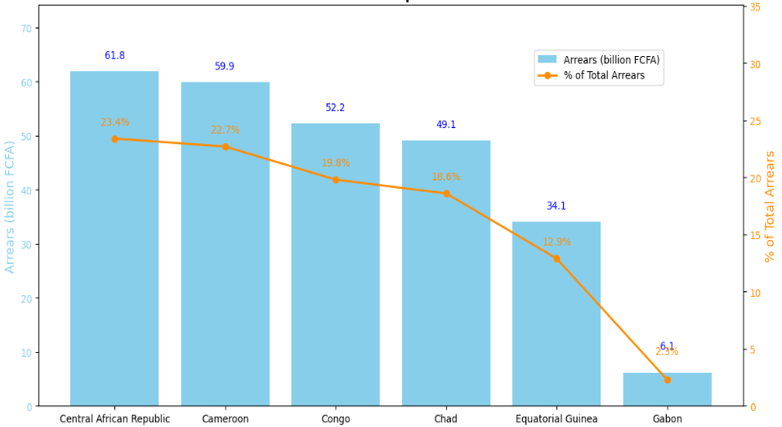
Figure 1: Arrears distribution and financial implications in CEMAC
Source: Authors from the parliamentary session report of the CEMAC Commission, Malabo.
Member states’ arrears to the CEMAC Commission reveal marked disparities: the Central African Republic, Cameroon, and Congo account for nearly 66% of the total, while Gabon contributes the least (2.3%). This concentration amplifies financial tensions, limits the Commission’s ability to finance regional projects, delays the implementation of integration programs, and weakens institutional credibility, undermining the confidence of partners and investors.
Risk assessment: challenges for the sub-region
- Currency and financial stability
Weak governance and costly payment delays risk undermining confidence in the CFA franc. Despite efforts to strengthen currency repatriation mechanisms (+324% between 2018 and 2024), fiscal uncertainty remains high, increasing the macro-financial fragility of the area.
- Fiscal vulnerabilities
Often exceeding 70% of GDP in several member states, high levels of public debt reduce the room for maneuver to respond to external crises or to invest in structural development programs. The absence of a regional stabilization framework exacerbates these vulnerabilities, leaving each country individually exposed to economic shocks.
- Limited trade and integration
Intra-regional trade integration remains one of the union’s weakest links: with intra-CEMAC trade accounting for less than 5% of total trade, the zone lags behind the standards observed in other African regional unions. This weakness hinders the creation of regional value chains, economic diversification, and market expansion.
Actionable policy recommendations
To turn the current crisis into an opportunity for structural reform, it is essential to adopt a series of practical and coordinated measures:
Reform of ICT collection
- Digitize the collection system to ensure transparency and traceability (electronic tracking platforms, automated notifications).
- Establish graduated penalties and incentive mechanisms to ensure regular payments (progressive tariff advantages, access to certain funds for states in good standing).
- Integrate periodic external audits to strengthen the confidence of member states and financial partners.
Establishment of a regional stabilization fund
- Create a budget stabilization fund financed by the Community Integration Tax, dedicated to cushioning external shocks (fall in commodity prices, health crises, etc.).
- Define clear criteria for access to this fund, based on prudent macro indicators and validated by an independent regional committee.
Institutional strengthening
- Clarify the institutional mandates of each CEMAC body to avoid overlap and strengthen supranational authority.
- Establish a regional economic arbitration body capable of intervening to resolve disputes between member states or to ensure the application of rules.
- Introduce regular peer reviews to encourage compliance with budgetary and fiscal commitments.
Promoting economic integration
- Gradually remove non-tariff barriers and harmonize customs procedures to facilitate intraregional trade.
- Invest in regional infrastructure corridors (transport, energy, digitization), particularly through public-private partnerships.
- Encourage innovation and training policies to stimulate productive diversification.
Conclusion
CEMAC is at a critical juncture. The suspension of institutional activities highlights significant structural weaknesses in the region’s economic and financial governance. With substantial arrears, low Community Integration Tax collection rates, and limited trade integration, a coordinated response is needed, focusing on ambitious structural reforms. By implementing innovative financing mechanisms, overhauling the Community Integration Tax, establishing a regional stabilization fund, strengthening institutions, and accelerating economic integration, CEMAC can address the current crisis and establish sustainable, stable, and inclusive integration.

Dr Vessah Mbouombouo Salim Ahmed
Mr Vessah Mbouombouo Salim Ahmed currently holds a PhD in Development Economics from the University of Yaoundé II-SOA. He holds a research Master II in Monetary and Banking Macroeconomics, and his research interests focus mainly on development economics.

Dr. Pippie Hugues
Dr. Pippie Hugues is a Policy Analyst at the Governance and Democracy Division of the Nkafu Policy Institute. He holds a Ph.D. in International Law with specialty in Human Rights, Conflict and Peace building.




Leave A Comment