
By Stéphane Mbiankeu Nguea
Executive Summary
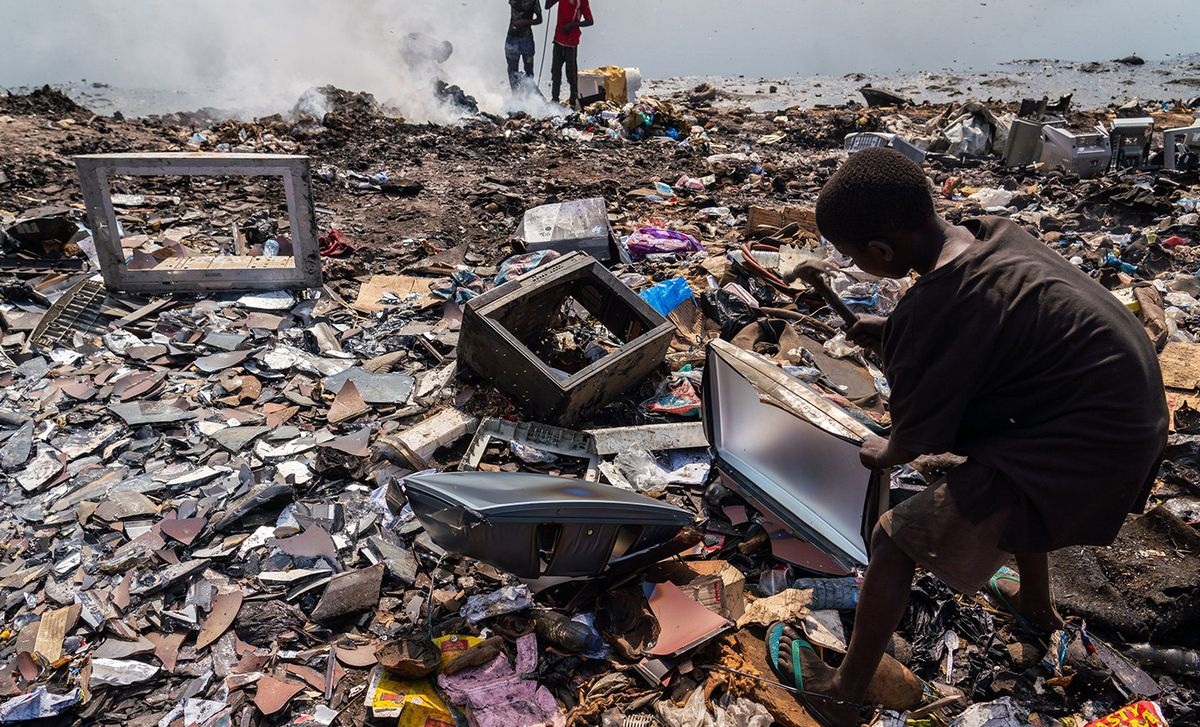
Cameroon generates an estimated 23,000 tonnes of electronic waste (e-waste) annually. Less than 10% of e-waste is safely recycled. The rest is burned and dismantled by informal workers without protection, releasing lead, mercury and cadmium into soil, water and air. Cameroon passed Africa’s first e-waste law with EPR in 2012. Ten years later, it is still not enforced: only 2 of 25 operators are active, no fees are collected, no fund exists, no one monitors compliance. The policy puzzle is this: why has a decade of pioneering legislation failed to produce safe e‑waste management? The answer lies not in the law itself but in three binding constraints: (1) the absence of enforcement, (2) the economic dominance of the informal sector, which externalises all environmental and health costs, and (3) the lack of a formalisation strategy that integrates informal workers rather than competes with them. Given these constraints, regulation alone cannot succeed. Effective actions require a dual strategy: first, enforce the existing decree; second, launch a national programme to formalise informal e‑waste collectors into legally recognised cooperatives – providing them with safety training, protective equipment, and market access to licensed recyclers.
Key Messages
- Cameroon’s digitalisation has brought progress, but discarded electronics – containing lead, mercury, and brominated flame retardants – poison communities and contaminate water sources.
- The 2012 e‑waste decree is pioneering, but unenforced. Formal recyclers cannot compete with informal operators who pay no environmental or health costs.
- Informal workers already collect and dismantle e‑waste. Giving them legal status, training, and safety equipment transforms a hazard into a green jobs engine.
Introduction
Cameroon generates approximately 23,000 tonnes of e‑waste annually – the equivalent of nearly 900 fully loaded trucks. Yet less than 10% is formally collected. The vast majority ends up in the hands of informal workers, who receive no formal training. In 2012, Cameroon issued Decree No. 2012/116, requiring producers, importers, and sellers of electrical and electronic equipment to take responsibility for end-of-life products under the Extended Producer Responsibility (EPR) approach. This made Cameroon, the first African country to adopt it. “Solidarité Technologique”, an NGO based in Yaoundé, one of the early licensed operators, gathers around 130 tonnes every year, which only 50 tonnes are properly processed. However, Solidarity remains the exception. Of the 25 operators that obtained licences, only two remains active today. The informal sector persists – not because the legal framework is flawed, but because it has never been effectively enforced. No enforcement mechanism exists. No financing mechanism channels EPR fees to collection and recycling. No strategy integrates the thousands of informal workers who constitute the de facto e‑waste management system. These brief addresses two questions. First, why has legislation alone failed to produce safe e‑waste recycling in Cameroon? Second, what practical policy shifts can address this failure – not through new legislation, but trough enforcing existing provisions and formalising the informal sector? The analysis proceeds as follows. Section one diagnoses the binding constraints that have rendered the 2012 decree ineffective. Section two examines African models (Uganda and Nigeria) that have formalised informal e‑waste workers into cooperatives. Section three draws policy implications for Cameroon. Section four concludes.
The Binding Constraints – Why a Decade of Legislation Has Failed
No Enforcement, No Compliance
Cameroon’s 2012 e‑waste decree is, on paper, a model for the region. It defines producers broadly (importers, sellers) and assigns them responsibility for take‑back, recycling, and safe disposal. However, a decade later, the decree remains largely unimplemented. No EPR fee is collected. No central fund finances collection or recycling. No inspectorate monitors compliance. The result is a market failure: formal recyclers incur costs for safe dismantling, storage, and transport, while informal operators face none. “Unlicensed recyclers take what is useful and toss out the rest, including items that are toxic for the environment,” notes the director of Solidarié Technologique. The informal sector is not illegal because it is harmful; it is illegal because it operates without a licence. However, with no enforcement, the distinction is academic.
Economic Dominance of the Informal Sector
Across Africa, informal workers perform the vast majority of e‑waste processing. In Cameroon, this is certainly true. The scrap‑metal district of Yaoundé is in full swing, with artisanal workers scavenging through discarded items and selling their harvest to traders. These workers are critical stakeholders in the e-waste value chain. They are not enemies of the environment. They are entrepreneurs operating without capital, equipment, or legal protection. The informal sector’s economic logic is simple: by externalising health and environmental costs (no PPE, no fire prevention, no safe storage), it can pay collectors higher prices for e‑waste than formal recyclers can. This creates a downward spiral: the more successful the informal sector becomes, the harder it is for formal operators to survive. In addition, with no enforcement, there is no incentive to change.
The Absence of a Formalisation Strategy
Perhaps the most damaging omission has been the failure to recognise that informal workers are not going to disappear. They are the de facto e‑waste management system of the country. Criminalising them or ignoring them will not make them go away; it will only drive them further underground. What is needed is a strategy that gives informal workers a pathway to formalisation – not as a favour, but as a core component of national e‑waste policy. Given their centrality, their inclusion is necessary for any successful policy. This means legal recognition, safety training, access to finance, and integration into the formal recycling chain. Without this, any enforcement of the 2012 decree will simply punish the poor without creating an alternative.
Two African Models That Work – Uganda and Nigeria
Uganda: The Bidibidi Electronic Waste Management Cooperative Society (BEMCoS)
What started as a youth‑led e‑waste community collection and repair system in the Bidibidi refugee settlement in 2022 became a registered cooperative (BEMCoS) in December 2024. With three repair hubs and mobile tricycles, the 30‑member team now offers paid repair services across five zones, serving both refugee and host communities. A recent IOM‑commissioned study found that the initiative is commercially viable and ready for expansion. The Ugandan model works because it focuses on cooperative formalisation – informal collectors are registered as a legal entity, provided with basic equipment and training, and then linked to markets for their materials. The cooperative structure also provides collective bargaining power and access to micro‑credit. For Cameroon, the lesson is clear: cooperative models can achieve viability with minimal capital, making secondary cities (Dschang, Bafoussam, Bamenda) ideal pilot sites where informal networks are smaller and more accessible.
Nigeria: NESREA’s Cooperative‑Led EPR Model
Nigeria’s National Environmental Standards and Regulations Enforcement Agency (NESREA) is actively rolling out a Cooperative‑Led EPR Model designed to organise informal waste actors into recognised cooperatives, providing them with legal identity, digital inclusion, financial access, and social protection. “The cooperative‑led model presents an opportunity to organise waste actors into recognised cooperatives, provide them with legal identity, digital inclusion, financial access and social protection,” said NESREA Director‑General. The Nigerian approach is particularly relevant to Cameroon because it explicitly integrates informal workers into the formal EPR framework. Instead of competing with them, the government uses the EPR fees paid by producers to finance training, equipment, and market access for cooperatives. The transferable insight for Cameroon is that EPR fees can directly fund formalisation – training, PPE, and equipment – rather than simply disappearing into government accounts, and that legal recognition under OHADA must precede enforcement.
Policy Recommendations for Cameroon
Enforce the 2012 Decree
Government should enforce the 2012 Decree with a dedicated unit within MINEPDED (Ministry of Environment, Nature Protection and Sustainable Development), with the mandate and budget to inspect importers, monitor recyclers, and gradually bring informal operators into compliance. This unit should be empowered to collect the EPR fees already provided for in the 2012 decree, depositing them into a National E‑waste Fund that finances collection, transport, and recycling infrastructure. However, enforcement must be phased and accompanied by formalisation. The first phase should focus on importers and producers – ensuring that EPR fees are paid. The second phase should bring informal collectors into compliance by offering them registration, training, and equipment, not fines.
Pilot a Cooperative Formalisation Programme in Secondary Cities
Yaoundé and Douala already have licensed recyclers and more complex informal networks. However, secondary cities – Dschang, Bafoussam, Bamenda, Ebolowa – have no formal system, smaller and more accessible informal networks, and supportive local councils. They also generate significant e‑waste (university towns like Dschang are major sources). Cameroon should immediately pilot a cooperative formalisation programme in secondary cities. This pilot would register informal collectors as a legal cooperative under OHADA law, provide basic PPE (gloves, masks, boots) and safety training, establish a simple collection hub (shipping container), and link the cooperative to a licensed recycler for downstream processing. The pilot would require no new legislation – only administrative action by MINEPDED, MINEFOP, and the local council. Once proven, it can be replicated nationally.
Operationalise the EPR Fee Mechanism Without Delay
Implementing the 2012 decree’s EPR provisions would generate revenue from electronics importers and producers. That revenue – channelled through a National E‑waste Fund – can finance collection, transport, and recycling infrastructure. In the short term, development cooperation instruments (e.g., GEF Small Grants Programme, UNDP, EU) can provide seed funding for cooperative pilots. Cameroon’s own national budget can also allocate modest resources for enforcement and training. MINEPDED should immediately operationalise the EPR fee mechanism provided for in the 2012 decree. Simultaneously, it should approach development partners for pilot funding. No new taxes or complex financing mechanisms are required – only the political will to use existing legal and financial instruments.
Conclusion
Cameroon has been hoping for a decade that a pioneering e-waste legislation could alleviate the rising challenge of electronic pollution. It has not. Not because the law is incorrect, but because enforcement has been neglected and the economic realities of the informal sector ignored. Enforcement without formalisation drives informal workers underground; formalisation without enforcement leaves licensed recyclers undercut. Thousands of Cameroonians already gather, deconstruct, and recycle e-waste daily. They do so without protection, legal standing, or market access. Formalising them into cooperatives, providing them with PPE, training, legal recognition, and access to licensed recyclers, turns a health threat into a green job engine. Nigeria and Uganda are demonstrating that cooperative models work in African conditions. Cameroon’s own 2012 decree provides the legal foundation. What remains is the political will to shift from legislation to implementation – from writing rules to enforcing them, and from competing with informal workers to empowering them. Without this dual action, e‑waste will continue to pile up in dumps and burn in backyards. With it, Cameroon, as the first African country to pass e‑waste legislation, can lead the region in turning a mounting crisis into a struc




Leave A Comment