
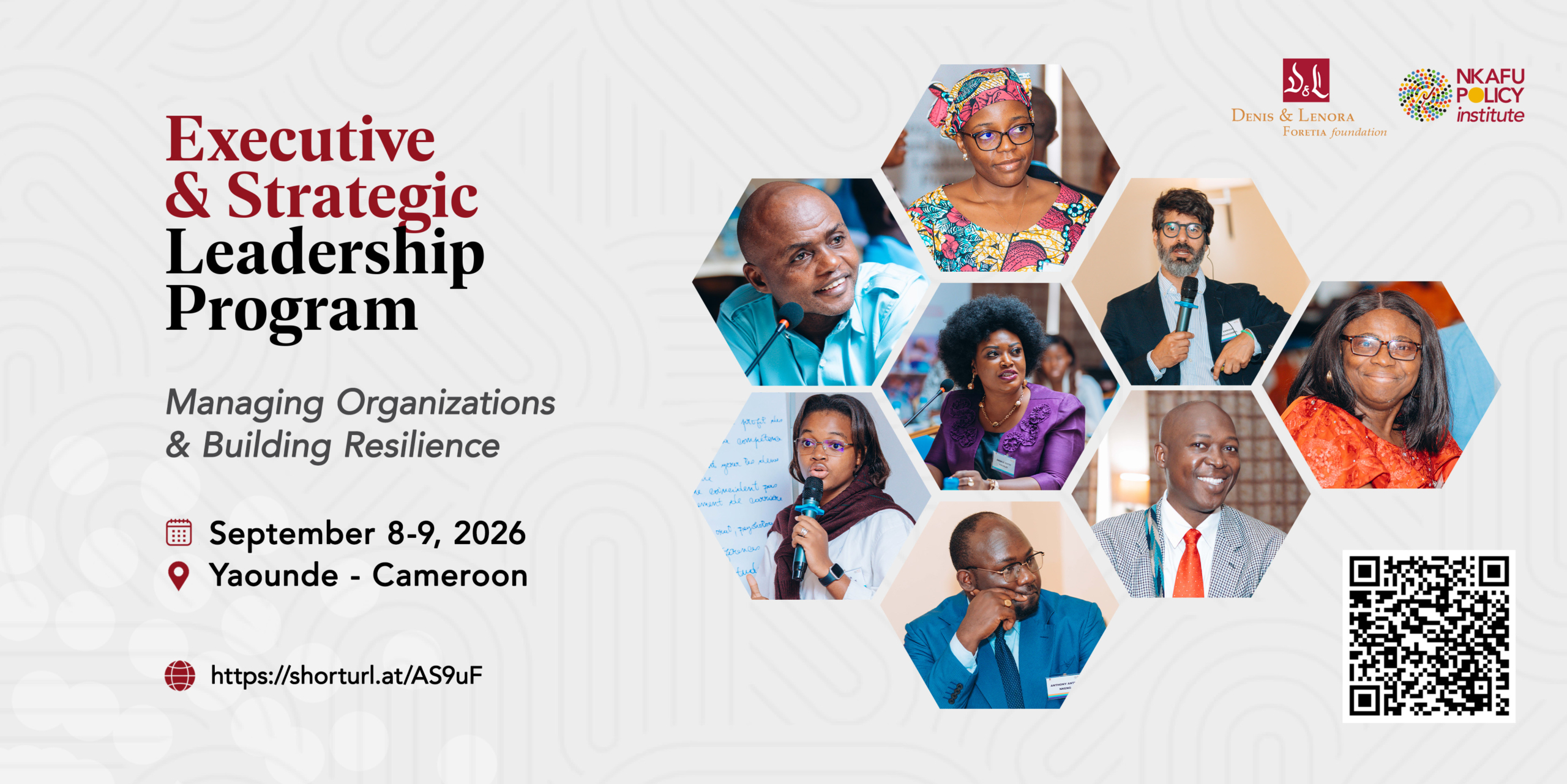
From sustainable financing and high-performance cultures to policy influence and regional collaboration, the 2026 Executive and Strategic Leadership Program (ESLP) is confronting a question with implications far beyond the boardroom: How can African institutions become resilient enough to navigate uncertainty, grow sustainably and shape the policies that will define the region’s future?
In an era of accelerating economic, technological, political and social change, African institutions face a common challenge: remaining relevant, resilient and influential amid uncertainty, resource constraints and increasingly complex policy environments. This is particularly evident in Central Africa, where institutions are navigating economic diversification, regional trade and integration, climate resilience, energy and digital connectivity, food security, governance, security and sustainable management of natural resources.
Organizations in Central Africa increasingly operate at the intersection of economic, technological, political and social pressures. Leaders must make decisions with incomplete information, adapt quickly and anticipate emerging risks.
For institutions in the region, these pressures are tangible. Governments may simultaneously confront food-price pressures, climate shocks, insecurity and demands for public services. Businesses operating across borders face infrastructure constraints and changing regulations, while think tanks and Civic organizations (CSOs) must respond to complex policy debates with limited resources.
This raises a fundamental question: Are African institutions designed for the world they are entering, or are they still structured for the world they inherited?
As we approach September 8–9, the 2026 Executive and Strategic Leadership Program (ESLP), scheduled to take place in Yaoundé, Cameroon, will provide a platform to examine five interconnected dimensions of institutional resilience and leadership under the theme: “Managing Organizations and Building Institutional Resilience.”
Leading through uncertainty requires institutions capable of anticipating change, learning, adapting and remaining focused on their mission.
1. From organizations that survive to organizations that grow
For many think tanks and CSOs, growth is constrained by dependence on short-term projects and external funding. Yet sustainability is also a challenge for private organizations, universities, research institutions and development agencies.
What does sustainable organizational growth look like in Central Africa?
It requires diversified financing, stronger fundraising, strategic partnerships, appropriate alternative revenue models, sound financial management and investment in institutional infrastructure.
This question is particularly important in a region rich in oil, minerals, forests and other natural resources, yet still facing significant development constraints. As Central Africa gains international attention around critical minerals, climate finance and the Congo Basin, the challenge is not simply attracting investment, but ensuring institutions have the capacity to negotiate, regulate and manage these opportunities sustainably.
This leads to a broader development finance question: How can development finance strengthen institutions rather than simply finance projects?
An institution cannot become resilient without resources for leadership, governance, talent retention, financial systems, communications and strategic planning. Development partnerships may therefore need to move beyond funding projects toward strengthening institutions capable of delivering impact over the long term.
2. Building high-performance cultures
Funding alone does not guarantee performance. Institutions also need effective leadership, accountability, teamwork, innovation, talent development, communication and clear performance expectations.
As illustration to this, accountability must operate at multiple levels: donors should hold leadership accountable; boards should hold management accountable; and staff and communities should have meaningful channels to hold institutions accountable to their commitments.
The challenge is equally about people: Can African institutions become places where talented professionals build careers rather than simply complete projects? High-performing institutions must invest in professional development, strong leadership and cultures that encourage learning, innovation and performance.
For Central Africa, this is particularly important as institutions compete to retain skilled professionals who increasingly have opportunities beyond the region.
3. Turning evidence into influence
Producing research is not the same as influencing policy. A think tank may produce excellent research without reaching decision-makers, while a CSO may document a social problem without influencing policy.
The central question is: How do African institutions convert knowledge and evidence into policy influence?
This is especially relevant as Central Africa becomes increasingly important in international debates on climate finance, the Congo Basin, critical minerals, food security, digital transformation, regional trade and economic diversification.
The process should extend beyond publication:
Research → Communication and dissemination → Stakeholder engagement → Advocacy → Policy influence → Societal impact → Policy feedback
Institutions must understand whether their recommendations reach decision-makers, influence deliberations and ultimately contribute to better outcomes.
International policy actors should also engage African organizations not only as implementers, consultants or research contractors, but as agenda setters, knowledge producers, policy partners and co-creators of solutions.
4. No institution can solve complex problems alone
Central Africa’s major challenges – climate change, trade, employment, food security, health, digital transformation, governance, migration and economic integration – exceed institutional and national boundaries.
Regional integration illustrates this clearly. For traders and businesses, integration is experienced through transport costs, border procedures, infrastructure and access to neighbouring markets. Digital transformation similarly depends not only on technology but on whether businesses, researchers, students and public institutions can meaningfully participate in the digital economy.
Governments, businesses, CSOs, think tanks, universities, development partners, investors and communities therefore need to bring complementary capabilities to shared challenges. During the Executive and strategic Leadership Program our aim is to create avenues that ensure that collaboration can become an institutional strategy for resilience and growth, rather than simply a mechanism for networking. The ESLP’s emphasis on peer learning and leadership cohorts across Africa reinforces this approach, enabling institutions to strengthen their capacity through shared experience, partnerships and learning.
Together, these challenges raise a fundamental question: What kind of institutions does Central Africa need to navigate the next decade?
The answer is institutions that are strategically led, financially sustainable, adaptable, evidence-driven, influential, collaborative and capable of developing strong people.
5. The private-sector connection
These challenges are not sector-specific. A corporation facing market volatility, a university managing changing funding realities, a ministry responding to complex public demands and a think tank seeking sustainable financing may have different mandates but face similar leadership questions:
How do we make better decisions? How do we attract and retain talent? How do we finance growth? How do we adapt? How do we communicate? How do we build partnerships? How do we remain relevant?
For Central Africa, these questions are connected to broader economic transformation. Businesses need predictable markets and regional trade; governments need private-sector partners capable of creating jobs and diversifying economies; research institutions need pathways to translate knowledge into innovation; and civil society needs stronger partnerships to influence policy.
This cross-sector dimension strengthens the strategic value of the ESLP by enabling leaders to learn beyond their own sectors and identify shared approaches to resilience, leadership and growth.
Conclusion
The future of development in Central Africa will depend not only on good policies, funding or well-designed projects, but on the strength of the institutions expected to turn resources, knowledge and policies into sustained impact.
The region sits at the centre of international debates on the Congo Basin and climate action, critical minerals and the energy transition, food security, regional trade, digital transformation, infrastructure, energy access and locally led development. Central Africa’s ability to shape these debates will depend significantly on the strength and credibility of its institutions.
This requires moving beyond measuring institutions primarily by the projects they deliver. Strong institutions need the leadership, systems, people, financing, knowledge and partnerships to endure, adapt and grow. They must turn regional challenges into policy agendas, evidence into influence and partnerships into tangible outcomes for citizens.
For development partners, this means investing not only in projects but in the institutions capable of delivering results over time. For African organizations, it means greater ownership of financial sustainability, talent, policy engagement and partnerships. For governments and businesses, it means recognizing that resilient institutions are essential to effective policy, predictable markets and inclusive growth.
Ultimately, the question is not whether Central African institutions can survive uncertainty, but whether they can use it as a catalyst to become stronger, more innovative, connected and influential.
The region does not lack resources, ideas or capable people. Its deeper challenge is building institutions capable of bringing these assets together, translating them into better policies and ensuring that the benefits reach citizens across borders and generations.
This is the deeper proposition of the 2026 Executive and Strategic Leadership Program: strong institutions are not merely vehicles for development – they are part of the development itself.
By Ayukmba Nkonghonyor, Deputy Communications Director, Denis and Lenora Foretia Foundation
Email: [email protected]

Leave A Comment