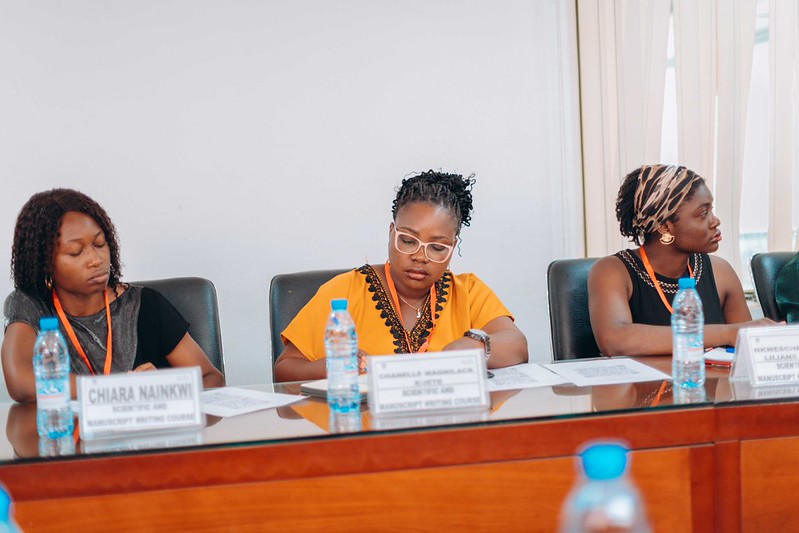
Equip young African researchers with advanced scientific writing skills.
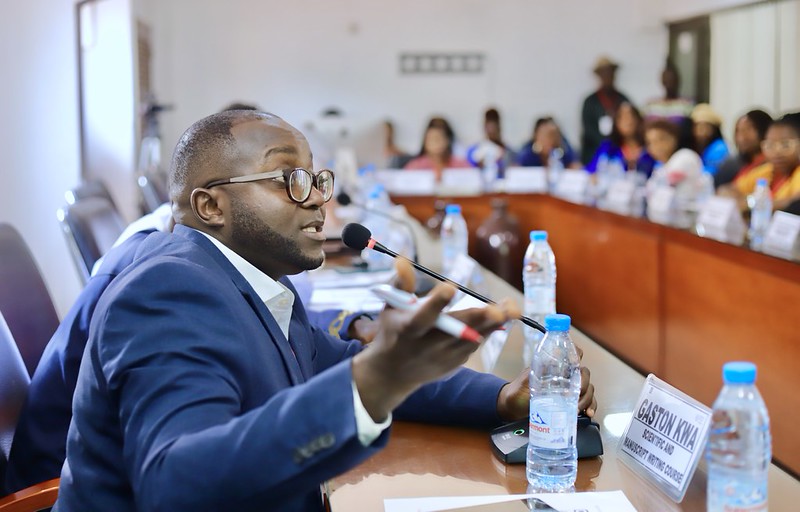
Strengthen participants' ability to effectively communicate research findings.
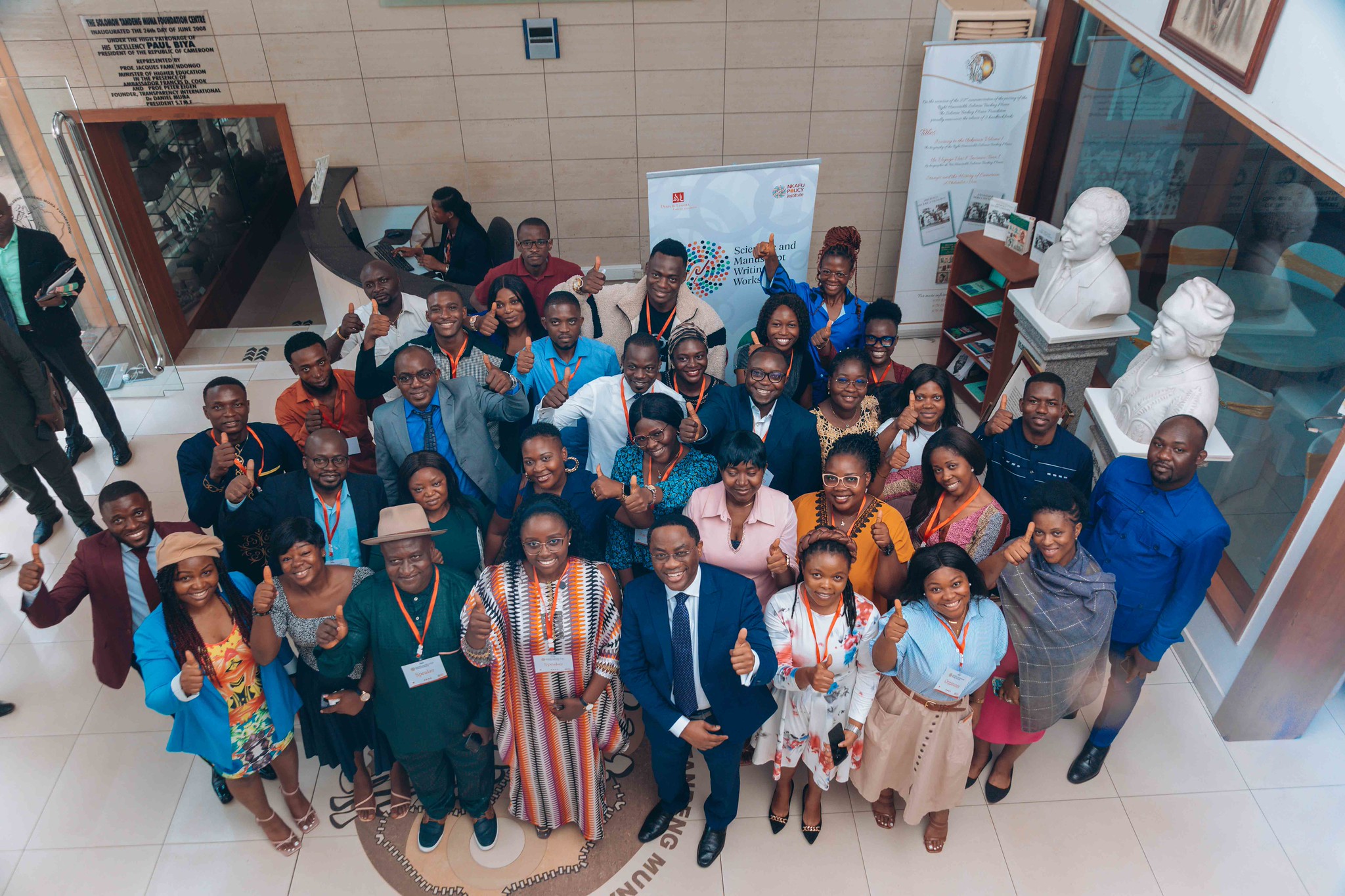
Foster a network of mentorship in scientific writing and publication.
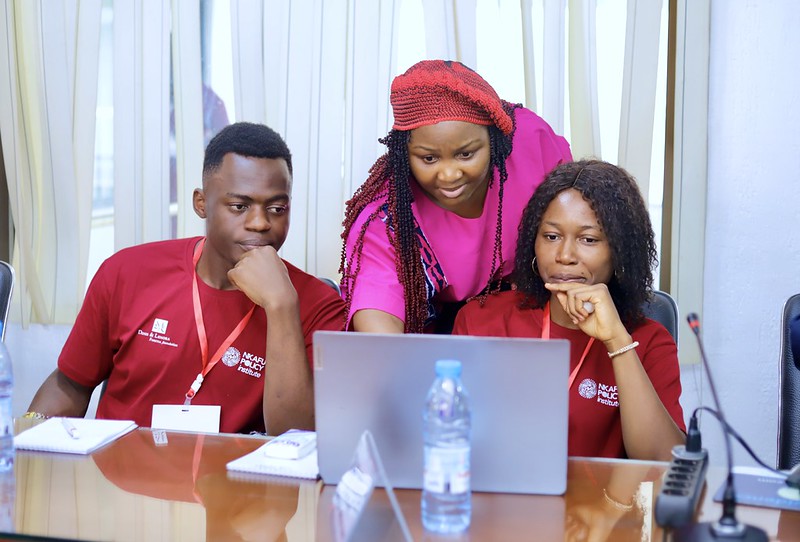
Instill best practices in ethical publishing and research integrity.
Dr. Denis Foretia
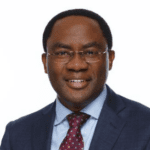 Dr. Denis Foretia is Co-Chair of the Denis & Lenora Foretia Foundation and Executive Chairman of the Nkafu Policy Institute, a leading Cameroonian think tank. Along with co-chair Lenora Ebule, he shapes and approves strategy, advocates for the foundation, and helps set the overall direction. He is also the Chairman of Merckshire LLC, an international holding company with operations in the US and Cameroon. A surgeon by training, Foretia has always been involved in philanthropic activities and issues related to international development. He is currently the President of the Association of Cameroonian Physicians in the Americas (ACPA). He is also the Co-Founder and pioneer president of the Cameroon Professional Society (CPS) – the premier institution for Cameroonian professionals in the US focused on advancing economic opportunity and leadership development among Cameroonians.
Dr. Julienne Mesumbe
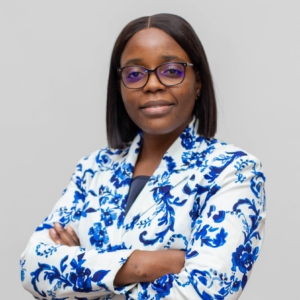 Dr. Julienne Stéphanie Mesumbe is the Strategic Information, Continuous Quality Improvement, and Health Informatics Team Lead for the TIDE Cameroon program. In this position, she oversees activities to improve program performance and equips employees and facility staff with the tools to manage and sustain continuous quality improvement methodologies.
Prior to joining Georgetown University, Dr. Mesumbe worked at the Elizabeth Glaser Pediatric AIDS Foundation as the Strategic Information and Evaluation Manager and most recently as the Head the Program Optimization and Service Quality Improvement Unit for the HIV-Free and Atteindre95 projects. Focused on the Center and Littoral regions of Cameroon, Dr. Mesumbe was responsible for producing strategic documents for quality improvement, and served as a resource for all staff at the site, district, and regional levels on quality management and performance improvement techniques.
She has also worked at International Medical Corps, where she led monitoring and evaluation for a project on integrated health, nutrition care, and protection assistance for Central African Republic refugees in three regions of Cameroon. Before that, she worked as a Program Officer at M.A.SANTE, a national NGO, where she led monitoring and evaluation for the project “Sustainable Cholera Surveillance for Cameroon”, and later served as principal investigator for the project “SMS4Care: Community-based surveillance of morbidities and demographic indicators using text message on ODK Collect”.
Dr. Constantine Ashangwa
 Dr. Asahngwa Constantine holds a PhD in Medical Anthropology from the University of Yaounde 1, Yaounde, Cameroon. He obtained his Master’s Degree in Medical Anthropology and Bachelor’s Degree in Anthropology both from the University of Yaounde 1, Cameroon. He has served as Director for the Cameroon Center for Evidence Based Health Care for 10 years as an evidence synthesis, translation and utilization expert. He has also served as a Senior Adjunct Lecturer at the School of Public Health, Faculty of Health Sciences, University of Adelaide, South Australia for 10 years, His research areas are in health policy, health systems, infectious diseases and reproductive health.
Dr. Ronald Gobina
 Dr. Ronald Gobina is a Nephrologist, working with the Regional Hospital in Buea. He is Director of the Health Policy and Research Program at the Nkafu Policy Institute and the Director of the COVID-19 taskforce for the Foretia Foundation. He is member of the Cameroon Society of Nephrology (CASONEPH), the International Society of Nephrology (ISN) and the Initiative to Strengthen Health Research Capacity in Africa (ISHReCA).
He is passionate about sharing knowledge and skills through every means possible. He believes that being a specialist is not about being superior but about being a better coach to advance expertise in any given sphere. As a general practitioner, he has initiated several teaching and coaching opportunities including the hospital-based teaching program at the Buea Regional Hospital for practicing nurses, doctors and trainees, and the Renal Summit for the South West Region of Cameroon which saw its maiden edition bring together experts from around the world to capacitate health personnel in the region on renal diseases. A regular choice for health education on radio platforms and with several community events for sensitization and screening organized, his determination continues to be seen in communities.
Dr. Odette Kibu
Dr. Odette Kibu is a Senior Health Policy Analyst at the Nkafu Policy Institute and PhD holder in Public Health at the University of Buea. She hold a Masters Degree in Chemical Pathology and a Bachelors Degree (Hons) in Biochemistry also from the University of Buea. Prior to joining the Foundation Ms. Kibu was a Research Assistant in Public Health at the University of Buea under the supervision of Prof. Dickson Shey Nsagha. She also previously worked at the Clinton Health Access Initiative.
Dr. Ignatius Esene
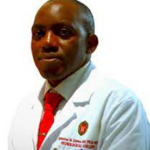 Dr. Ignatius Esene is a Neurosurgeon-Scientist. He works as a Consultant neurological surgeon, Public, International & Global Health Physician. He is currently the Head of the neurosurgical unit of the Garoua regional hospital. Dr Esene is also the Deputy Editor-In-chief, Journal of Global Neurosurgery (J GNS) and the Co-Founder/Scientific Editor of the Pan African Medical Journal-Clinical Medicine. He was recently elected Secretary general of the Continental Association of African Neurosurgical Societies (CAANS).
Dr Ignatius Esene obtained his Medical Doctorate Degree from Cameroon and was awarded the Academy of Research and Higher Education scholarship to undertake a Masters in Public Health (in Brussels, Belgium) which he obtained with a Magna Cum Laude. He then proceeded to Cairo for his residency in Neurosurgery. He obtained a Masters in Neurosurgery/Neurology (cum laude) and Doctorate Degree (Ph.D) in Neurological Surgery under the aegis of the World Federation of Neurosurgical Societies and auspices of the Cameroonian government.
He equally holds Postgraduate Certificates/Diplomas in Health Economics, International Health, Advanced Research Methods, Pediatric Neuro-Oncology, Skull Base and Neuro-Vascular Surgery. He has received a myriad of accolades, travel/boarding grants and a manifold of scholarships (WFNS Foundation Scholarship, FIENS-Basset Global Neurosurgery Fellowship, NIH-StrokeNet Fellowship, InWEnt-Health Division Grant).
Desmond Jumbam
 Desmond Jumbam is a global surgery research and health systems consultant. He earned his bachelor's degree in biological sciences with a minor in chemistry from Taylor University (magna cum laude) in 2015 and a master of science in global health from the University of Notre Dame in 2016. Currently, he serves as Director of Health Policy and Advocacy at Operation Smile, an international non-governmental organization that aims to improve access to safe and timely surgical care globally. Desmond is also a 2022 News Voices Fellow at the Aspen Institute and the president and co-founder of the Jumbam Family Foundation, based in Cameroon. The Jumbam Family Foundation aims to provide psychosocial and reintegration support to victims of the ongoing Anglophone war in Cameroon. Desmond serves on the editorial boards of BMC Health Services Research, PLOS Global Public Health, and Frontiers. He is a board member of King’s Global Health Partnership at King’s College London.
Dr. Nadege T. Fackche
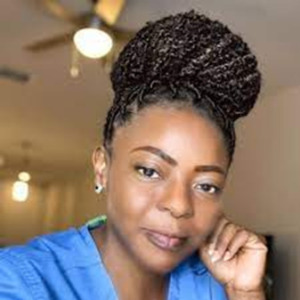 Dr. Nadege T. Fackche is a general surgeon in Washington, District of Columbia and is affiliated with Northwest Hospital. She received her medical degree from University of South Carolina School of Medicine in 2015 and has over 10 years of experience in medical practice. She is author of over 20 publications in reputed journals and conference papers. Her areas of expertise and research interest include surgical oncology, cancer surgery, colorectal surgery.
Dr. Nicholas Okumu
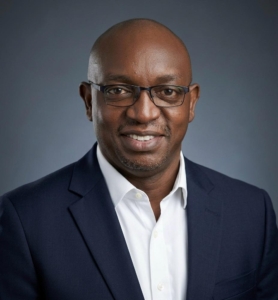 Dr. Nicholas Okumu is an orthopaedic oncologist and one of only a few subspecialists in this field serving
Kenya's 55 million population. He leads the Orthopaedic Oncology Unit at Kenyatta National Hospital,
where he established the country's first orthopaedic oncology multidisciplinary team and lectures in the
Department of Surgery at the University of Nairobi. He previously served as Head of the Department of
Orthopaedics at Kenyatta National Hospital.
Dr. Okumu is also a healthcare entrepreneur. He is Managing Partner of Jasmine Healthcare (Jasmine
Dental and Medical Centre LLP), a medical centre based in Nairobi Kenya. Its e-pharmacy focused on
chronic disease management has secured investment from Antler Africa, with a 1-million-dollar post-seed
valuation. He previously founded and exited Traitem Healthcare, a pharmaceutical distribution company,
and has also served as CEO of Stratus Medical and Imaging Services Ltd, a diagnostics provider based in
Nairobi, which built a teleradiology network serving 13 institutions and 100 plus locations.
He holds a Doctor of Medicine (MD) from the University of Dar-es-Salaam, a Master of Medicine (MMed)
in Orthopaedic Surgery from the University of Nairobi, an MBA from the University of South Wales, and a
Diploma in Orthopaedic Oncology from the British Orthopaedic Oncology Society. He is a certified Project
Management Professional (PMP). His training includes executive education in surgical leadership (Harvard
Medical School), AI in healthcare (MIT Sloan), health economics (London School of Economics), and
project management (University of Cape Town).
As a 2024 Global Surgery Advocacy Fellow with Operation Smile, the University of Global Health Equity,
and the Nkafu Policy Institute, Dr. Okumu developed sarcomalearning.africa, a free online training platform
that equips primary healthcare workers to detect musculoskeletal cancers early. He also authored Kenya's
National Training Manual for Early Sarcoma Detection and contributed to the development of Kenya's
National Surgical, Obstetric and Anaesthesia Plan. He is currently participating in the Global Surgery
Slingshot, a cohort focused on improving access to safe minimally invasive surgery in rural areas. Dr.
Okumu has been accepted as a 2025 Byron Fellow, a selective leadership development program for social
and environmental entrepreneurs advancing transformational change in health and natural communities.
His current research focuses on AI-powered healthcare solutions for low-resource settings. He is Kenya
Principal Investigator for the AFRETEC consortium, developing 3D-printed prosthetics for limb salvage
surgery. He is also Co-Investigator on an EU Horizon Europe grant with the University of Regensburg,
building AI-assisted ultrasound screening tools for bone malignancies. He recently has had the honor of
being appointed the Lead-Governance of AI for Healthcare for the community of practice under the Pan
African Health Informatics Network (HELINA).
Dr. Okumu is a published author of the fiction thriller Shadows Behind The Screen and is completing a
motivational book, Selective Excellence: Embracing Intentional Focus Over the Myth of Work-Life Balance.
He is a regular columnist for The Star newspaper in Kenya and has published in Devex, IPS Inter Press
Service, and The Elephant on issues of global surgery and African healthcare.
Antem Anthony
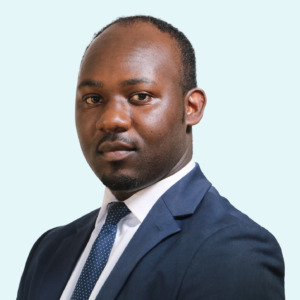
Antem Anthony is a Head of Conflict Prevention, and Analysis Unit at the Foretia Foundation. Prior to joining the Foundation, he served as conflict, policy and security assistant at the International Crisis Group, Kenya. He has equally served as political and communications intern at the Foreign, Commonwealth and Development Office/British High Commission in Yaoundé. Added to these, He has served as policy analyst for African Affairs at the African Online and Publications Library (AOPL).
Anthony is a certified administrative and operations professional from the United Nations University for Peace and the Pan African Institute for Development, West Africa (PAID-WA). He is currently finalizing a Professional Master’s Degree in International Relations/Disputes from the International Relations Institute of Cameroon (IRIC). He holds a Bachelor’s Degree in Public Administration and Law from the University of Yaoundé II, Soa.
Prof. William H. Arrey
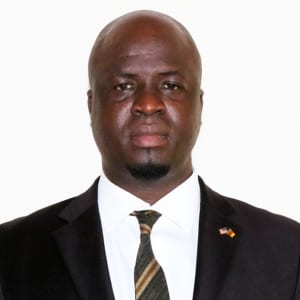
Prof. William Hermann Arrey is a Senior Fellow in Peace & Security /Governance & Democracy Policy Sections, Nkafu Policy Institute and Advisor to the Board. Prior to this, he served as interim CEO of the Foretia Foundation and Research & Policy Fellow with the Nkafu Policy Institute. He is also currently the Head of the Department of Peace and Development Studies at the Protestant University in Cameroon based in Yaoundé
Prof. Arrey brings a wealth of experience and senior leadership to the Foundation. He obtained his PhD in Peace and International Development Studies from the University of Bradford, United Kingdom; a Master of Philosophy (M.Phil) from the University of Tromso, Norway and a Bachelor of Science in Sociology and Anthropology from the University of Buea. He has published in many peer-reviewed journals and has written extensively on local governments, peace building and conflict transformation. He travels frequently for talks, lectures and presentations.
Dr. Ulrick Sidney Kanmounye
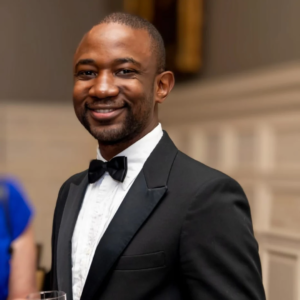
Ulrick Sidney Kanmounye is the Manager of the Policy and Advocacy Department at Operation Smile. Before joining Operation Smile, he was a research associate at the Program in Global Surgery and Social Change (PGSSC) – Harvard Medical School. During his time at the PGSSC, Ulrick worked with the Global Neurosurgery Initiative, the Southern African Development Community, and the Global Health Conference Equity team. As a member of the Global Neurosurgery Initiative, Ulrick led the global neurosurgical workforce and infrastructure projects. With the Southern African Development Community, he was part of a team that helped identify barriers faced my low- and middle-income country researchers at major global health conferences.
Ulrick equally served on the Secretariat Team of the World Federation of Neurosurgical Societies’ Global Neurosurgery Committee. Ulrick is passionate about medical education, and he has worked with students from all around the world, serving as a mentor and building capacity in this group. Notably, he is the founding President of the Association of Future African Neurosurgeons, an interest group for aspiring African neurosurgeons, and he served as ’19-’20 research sub-team lead of the International Student Surgical Network (InciSioN). Ulrick has published extensively on neurosurgery, global surgery, and medical education. He is an Associate Editor of the Journal of Global Neurosurgery and a Social Media Editor of the Journal of Neurological Surgery Part B: Skull Base.