
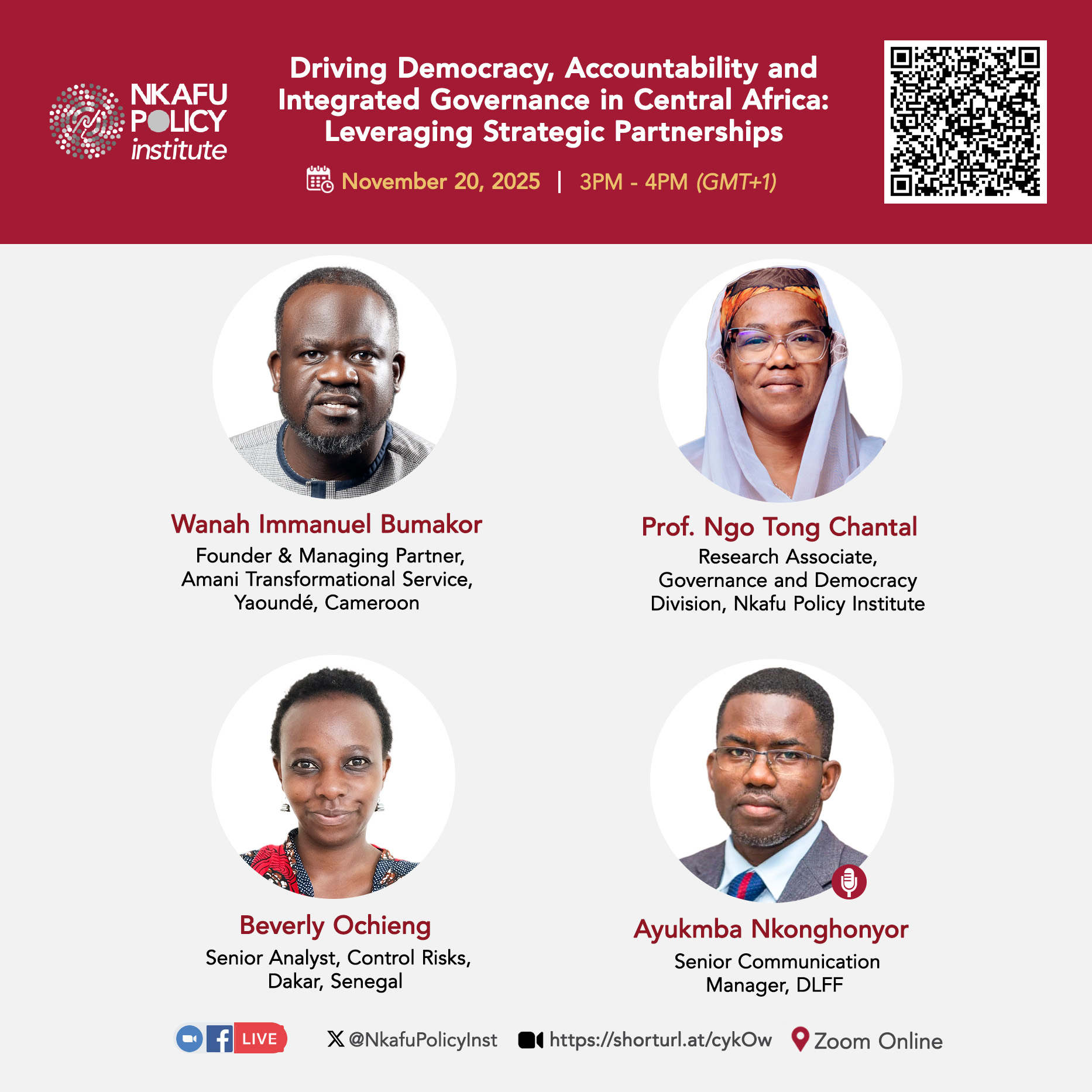
Driving Democracy, Accountability and Integrated Governance in Central Africa: Leveraging Strategic Partnerships
Date: November 20th 2025
Time: 3:00pm – 4:00pm (WAT
Venue : Zoom Online
Context
Democratic Deficits
The Central African sub region faces numerous challenges related to democracy, accountability and governance. The wave of political instability, longevity in power, unconstitutional changes of government, as well as civil conflicts in countries of the Central African sub region highlights the challenges to the consolidation of democracy. The region is plagued by weak governance structures, impeding efficient public administration and the establishment of democratic principles. Countries of the sub-region; notably, Cameroon, Chad, the Central African Republic, Gabon, The Republic of the Congo, the Democratic Republic of Congo (DRC), and Equatorial Guinea all rank consistently low on key democratic indicators (1). As a result, many countries in this region struggle with issues like corruption, human rights violation, limited civil liberties, weak rule of law, lack of free and fair elections, lack of accountability, and weak institutional frameworks; which all account for the low level of development in the sub region. International programs identify five major guidelines for strengthening democratic governance, including; The protection of fundamental rights, the reduction of economic and social inequalities, the construction of the rule of law, the promotion of political pluralism and Social pluralism (2).
The Case for Integrated Governance
Even though the afore-mentioned principles are crucial for bolstering democratic and integrated governance, their application remains difficult across the region because of deeply ingrained political cultures that are resistant to change. Faced with this challenge, there is need for a strategic approach that combines various elements of governance across different sectors to improve efficiency, accountability, sustainability, and service delivery for citizens. To achieve this, effective partnerships among governments, civil society organizations, international agencies, and private sectors is very essential. These collaborations have the potential to significantly contribute to the advancement of integrated governance frameworks, democratic principles, and accountability systems which are critical for sustainable development.
Objectives
This webinar is part of the SCATT-BRIDGE Project which aims to strengthen think tank resilience and democratic governance across Central Africa. The main objective of the webinar is to examine innovative partnership approaches that can strengthen the democratic process, enhance accountability and guarantee effective governance across the central African sub region. More specifically, the webinar seeks to:
- Analyze the current economic and socio-political landscape in the Central African Region and identify key challenges related to integrated governance, democracy and accountability.
- Exploreinnovative partnership models to close gaps in governance, democracy and accountability and promote constructive change in Central African government systems.
- Fosterdialogue on best practices for collaboration between international organizations, the corporate sector, civil society, and government authorities.
- Generateinsights to inform future programming and donor strategies in the
Expected Outcomes
At the end of the discussion, it is expected that:
- Attendees gain a more profound understanding of the specific governance challenges that theCentral African Region faces.
- Identification of Best Practices and successful cooperation models between stakeholders thatcan be adapted or duplicated within the region.
- Developmentof actionable recommendations to guide stakeholders in establishing effective partnerships with the goal of improving governance, democracy and accountability.
- Improved effectiveness and strategic alignment of future programming and donor strategies in the region.
Expected Outputs
Immediate output from this webinar includes;
- Arecording of the webinar that will be made available online for future
- Acomprehensive report that summarizes the webinar’s main discussion, key insights and actionable policy recommendations.
Target audience
The webinar is targeted for:
- Regionalgovernance experts
- Government officials from Central African countries responsiblefor public policy formulation, implementation, and evaluation
- AfricanUnion, RECs and RMs
- Donorrepresentatives
- Civilsociety leaders and advocates
- Developmentpractitioners from international organizations, with a focus on policy reforms
- Privatesector and media representatives engaged in public-private partnerships and policy advocacy
- PublicPolicy experts
- Womenand youth leaders
Event Format
The webinar will take place online, via zoom through an interactive panel discussion by experts and will be streamed live across all organizational media outlets.
Event Date
The one-hour long event is scheduled to hold on November 20th 2025 from 3:00pm to 4:00pm (WAT).
About the Denis & Lenora Foretia Foundation
The Denis & Lenora Foretia Foundation was established to catalyze Africa’s economic transformation by focusing on social entrepreneurship, science and technology innovation, public health, and progressive policies that create economic opportunities for all. The Foundation partners with local governments, policymakers, private enterprises, civil society organizations, and development partners to expand resources available to entrepreneurs, farmers, and small business owners, improving individual livelihoods.
About the Nkafu Policy Institute
The Nkafu Policy Institute is an African think tank with a mission to provide independent, in-depth, and insightful policy recommendations that enable all Africans to prosper in free, fair, democratic, and sustainable economies. The Institute’s team of analysts, experts, and researchers work on governance and democracy, health and education, peace and security, science and technology, and economic policy.
Contact
Questions related to the organization of this event can be sent to:
Ms. Muriel Kinkoh, Research Associate, Peace and Security division, Nkafu [email protected]
Nkafu Policy Institute P: (+237) 222 31 15 84 / (+237) 654 86 72 54 | www.nkafu.org
Date
- Nov 20 2025
- Expired!
Time
- 3:00 PM - 4:00 PM
Location
Organizer
-
Nkafu Policy Institute
-
Phone
+237 654 86 72 54 -
Email
[email protected] -
Website
https://nkafu.org/ Catalyzing Africa’s Economic Transformation
Leave A Comment