
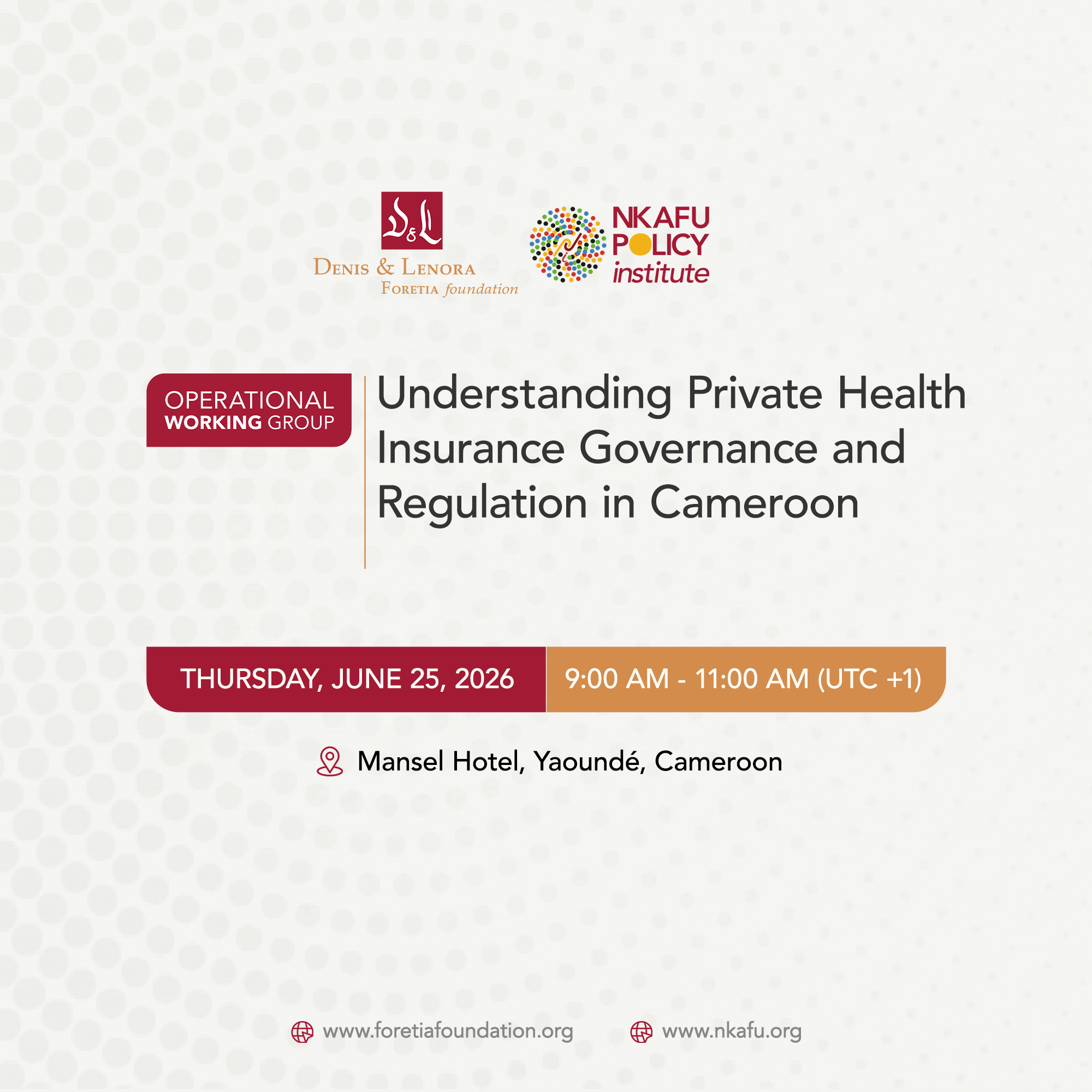
5th Operational Working Group: “Understanding Private Health Insurance Governance and Regulation in Cameroon”
Date: June 25, 2026
Time: 09:00am – 11:00am
Venue: COFE Hotel, Yaoundé, Cameroon
Background
Cameroon’s health financing system is characterized by high out-of-pocket expenditures, putting individuals at risk for unbearable healthcare expenses, financial vulnerability and sexclusion [1]. Although the government introduced its Universal Health Coverage (UHC) program in 2023, current implementation remains narrow in scope leaving part of the population exposed to financial constraints when seeking healthcare [2].
In response to this persistent health financial burden faced by households and the limited reach of public health financing mechanisms, private health insurance (PHI) has emerged as an alternative pathway to enhance financial protection and complement existing public efforts towards UHC [3]. However, the effectiveness of private health insurance depends largely on the strength of its governance and regulatory environment. In Cameroon, significant challenges persist in PHI governance and regulation, primarily due to fragmented oversight and weak regulatory coordination. While the Ministry of Finance and the insurance regulator (the Inter-African Conference on Insurance Markets) hold primary responsibility for licensing and financial supervision, the Ministry of Public Health plays only a marginal role in shaping benefit packages, monitoring service quality, or ensuring alignment with national health priorities. Consequently, critical aspects such as consumer protection, provider accreditation, and integration with universal health coverage goals remain underdeveloped. PHI schemes operate in isolation, with inconsistent standards and minimal accountability, creating risks of inefficiency, inequity, and exclusion of vulnerable populations.
Strengthening governance and clarifying institutional roles is therefore essential to build trust and ensure that private health insurance contributes effectively to affordable and equitable access to healthcare among Cameroonians. In this light, the Health Policy and Research Division of the Nkafu Policy Institute conducted the study “Understanding Private Health Insurance Governance and Regulation in Cameroon” under the project “Expanding Private health Insurance in Cameroon”.
This Operational Working Group aims at discussing the findings of the above-mentioned study and provide actionable recommendations to strengthen regulatory frameworks, clarify institutional roles, and promote equitable, efficient, and sustainable private health insurance practices in the country.
Objectives
- To examine the study findings to assess their implications for private health insurance in Cameroon.
- To draw lessons from best practices and comparative experiences, identifying approaches that could be adapted to the Cameroonian context.
- To develop actionable evidence-informed strategies to strengthen regulation, clarify institutional roles, and enhance oversight mechanisms for private health insurance in Cameroon.
Expected Outputs
The expected outputs are:
- A shared understanding among participants of the main governance and regulatory challenges identified.
- A short list of the most critical governance and regulatory gaps to address, based on the paper’s results and participants’ perspectives.
- A preliminary set of practical strategies to strengthen regulation, clarify institutional roles, and enhance oversight mechanisms for private health insurance in Cameroon.
Target Participants
This OWG will gather government representatives (Ministry of Health, Ministry of Finance, Ministry of Labour and social security), policymakers, insurance providers, health economists, subscribers and health policy experts, public health professionals, consumer protection groups, CSO and healthcare users.
Venue & Date
This OWG will take place onsite on June 25, 2026, at COFE hotel (Yaoundé) from 09:00am to 11:00am.
About the Organizers
- About the Denis And Lenora Foretia Foundation
The Denis & Lenora Foretia Foundation was established to accelerate Africa’s economic transformation by focusing on social entrepreneurship, science and technology, innovation, public health and progressive policies that create economic opportunities for all. The foundation works in partnership with local governments, policy makers, private enterprises, civil society organizations as well as development partners to expand the resources available to entrepreneurs, farmers, and small business owners in addition to improving individual livelihoods.
- About the Nkafu Policy Institute
The Nkafu Policy Institute is an African think tank with a mission to provide independent, in-depth and insightful policy recommendations that allows all Africans to prosper in free, fair, democratic and sustainable economies. The Institute is made up of analysts, experts and researchers from all over the world, working on a wide range of topics, including governance and democracy, health and education, peace and security, science and technology, and economic policy.
Date
- Jun 25 2026
- Expired!
Time
- 9:00 AM - 11:00 AM
Location
- Quartier Fouda Yaoundé, Cameroon
Organizer
-
Nkafu Policy Institute
-
Phone
+237 654 86 72 54 -
Email
[email protected] -
Website
https://nkafu.org/ Catalyzing Africa’s Economic Transformation
Leave A Comment